America’s ‘angriest’ theologian faces lynching tree
Share
Explore Our Galleries









Breaking News!
Today's news and culture by Black and other reporters in the Black and mainstream media.
Ways to Support ABHM?
By John Blake, CNN
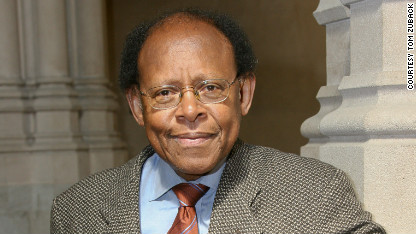
When he was boy growing up in rural Arkansas, James Cone would often stand at his window at night, looking for a sign that his father was still alive.
Cone had reason to worry. He lived in a small, segregated town in the age of Jim Crow. And his father, Charlie Cone, was a marked man.
Charlie Cone wouldn’t answer to any white man who called him “boy.” He only worked for himself, he told his sons, because a black man couldn’t work for a white man and keep his manhood at the same time.
Once, when he was warned that a lynch mob was coming to run him out of his home, he grabbed a shotgun and waited, saying, “Let them come, because some of them will die with me.”
James Cone knew the risks his father took. So when his father didn’t come home at his usual time in the evenings, he’d stand sentry, looking for the lights from his father’s pickup truck.
“I had heard too much about white people killing black people,” Cone recalled. “When my father would finally make it home safely, I would run and jump into his arms, happy as I could be.”
Cone takes on a theological giant
Cone left his hometown of Bearden, Arkansas, and became one of the world’s most influential theologians. But the memories of his father and lynch mobs never left him. Those memories shaped his controversial theology, and they saturate his recent memoir, “The Cross and the Lynching Tree.”
Cone, who once called himself “the angriest theologian in America,” is still angry. His book is not just a memoir of growing up in the Jim Crow era; it’s a blistering takedown of white churches, and one of America’s greatest theologians, Reinhold Niebuhr – a colossal figure often cited by the Rev. Martin Luther King Jr.
Read more about James Cone here.
We dedicate an online gallery to the victims of lynchings and one to the Jim Crow era through which Cone lived.
Our breaking news archive covers more notable Black Americans.
Comments Are Welcome
Note: We moderate submissions in order to create a space for meaningful dialogue, a space where museum visitors – adults and youth –– can exchange informed, thoughtful, and relevant comments that add value to our exhibits.
Racial slurs, personal attacks, obscenity, profanity, and SHOUTING do not meet the above standard. Such comments are posted in the exhibit Hateful Speech. Commercial promotions, impersonations, and incoherent comments likewise fail to meet our goals, so will not be posted. Submissions longer than 120 words will be shortened.
See our full Comments Policy here.