Claxton Dekle: Prosperous Farmer, Husband and Father of Two
Share
Explore Our Galleries

Breaking News!
Today's news and culture by Black and other reporters in the Black and mainstream media.
Ways to Support ABHM?
By Dr. Fran Kaplan
From information provided by Richard L. Byrd, great-great-nephew of Claxton Dekle
When he was lynched, Uncle Clax (1893 - 1917) was 24 years old. He and his wife Huddie had a 14 month old daughter, Myrtle, and Huddie was pregnant with their daughter Joe Britt, whom Claxton would not live to see born.
Claxton Dekle (pronounced Dee-cul) was part of a family that, by 1917, had obtained the American dream of their times: 40 acres and a mule. They owned a sizeable amount of land in Emanuel (now Candler) County Georgia.
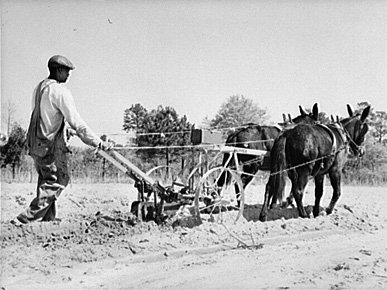
Plowing with a mule. Courtesy of the Library of Congress.
The circumstances leading to Uncle Clax's murder began when his father, Henry Dekle, decided the family needed another mule to plow their growing acreage. He sent Clax to buy one from a white farmer nearby.
Uncle Clax went into Metter, Georgia and bought the mule. Upon returning home, however, the family discovered that the mule was blind. They sent Clax back to either get another mule or get the family’s money back. But the farmer would neither take the mule back or return the money, even though he knew the mule was blind when he sold it. An argument ensued. According to reports, the farmer hurled “nigger” insults and attacked Uncle Clax. In turn, Clax defended himself at a time when it was death to insult or question the word of a white man–let alone cause him physical harm.
The Atlantic Constitution newspaper, not known for unbiased reporting of stories about people of color, reported that when Clax began to get the better of the white farmer, two white bystanders came to his aid. Nonetheless, Clax killed the white farmer, and Clax returned home and told what had happened, according to the story handed down in his family.
Meantime a mob formed. They captured and executed Uncle Clax. As was customary at the time, he was not given a trial, just immediately executed–the typical punishment for killing a white person, whether the killing was done in self-defense, as an accident, or with malice aforethought.
As Clax hung from a tree, the enraged mob riddled his body with bullets. When his great-great-nephew asked his cousin what happened next, she clasped her hands and held her head down. “They told me they drug him through Metter [for all to see]. . . . After they drug him for so long, it was one white man that told them [the mob] if they didn’t untie that man from that [buggy] and give him back to his people—because he was already dead—that he would start shooting. So they finally untied him and gave him to his people. . . . While they were having the funeral, those white people went to the grave and they meant to kill the whole family. They were hidden in the woods. And this other white man that made them untie [Clax] went to the church and told [the Dekle family], ‘Don’t y’all go to the cemetery because they plan to kill all of y’all.’”
The family heeded the warning and took the necessary precautions, scouting the area and waiting until the following morning to bury Uncle Clax. To save the family from further harm, Granddaddy Henry and his brother, Uncle Benjamin Dekle, changed the family’s name to Uncle Benjamin’s wife’s maiden name and left the area (as so many blacks did when their lives were in jeopardy). They knew they would receive no protection from their local authorities, who were often supportive of or even directly involved in the murder-by-lynching of blacks. Even though they were tax-paying US citizens, black people were on their own; they had no rights or protection by local governments and had little-to-no recourse at the state and federal levels.
In the end, the hard-working and proud Dekle family was forced to abandon their property, leaving behind decades of hard work and prosperity, simply because their lives were not as important as the man’s whose skin tone lacked pigmentation.
- To understand the far-reaching ramifications of this lynching for his descendants and the black community today, read Richard L. Byrd's blog article "Why Sing the National Anthem When We're Still Chanting."
- For the story of another prosperous black farmer who was lynched for protesting when a white man cheated him, read about Anthony Crawford.
- Please visit our Memorial to the Victims of Lynching to pay your respects to the 1900+ men, women, and children listed there. Help us to complete the list and humanize the victims by contributing names, life stories, and portraits by contacting info at abhmuseum dot org.
- Visit artist Jennifer Scott's moving exhibit, The Stories Behind the Postcards, about the effects on victims' families immediately following their murders.
Comments Are Welcome
Note: We moderate submissions in order to create a space for meaningful dialogue, a space where museum visitors – adults and youth –– can exchange informed, thoughtful, and relevant comments that add value to our exhibits.
Racial slurs, personal attacks, obscenity, profanity, and SHOUTING do not meet the above standard. Such comments are posted in the exhibit Hateful Speech. Commercial promotions, impersonations, and incoherent comments likewise fail to meet our goals, so will not be posted. Submissions longer than 120 words will be shortened.
See our full Comments Policy here.
This is my Great Great Uncle as well and I ask that this information lives on.