How the Pullman Porters Advanced Black Culture
Share
Explore Our Galleries

Breaking News!
Today's news and culture by Black and other reporters in the Black and mainstream media.
Ways to Support ABHM?
By Scholar-Griot: Eleanor Olbinski, MA
In the late 1800s, passenger rail travel was incredibly uncomfortable. The cars were loud, hot, crowded, and dirty. A young White engineer named George Pullman believed that passengers would pay an extra fee to travel in luxury. In 1865, George developed his first Pullman “palace” car, the first of a line of luxury rail cars that would become the country's largest “hotel” franchise.
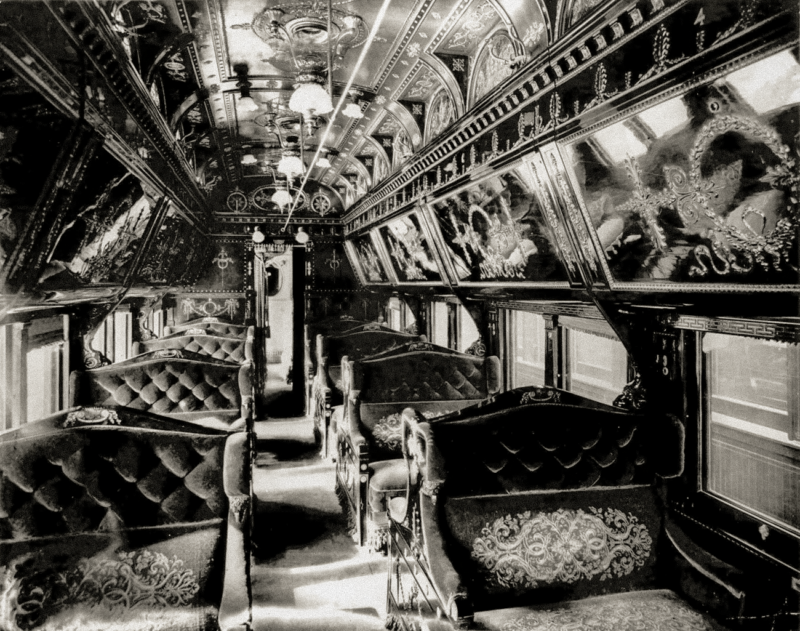
Pullman "palace" car. Pullman State Historic Site
Within the first couple of years of the company, it became clear that the Pullman cars needed quality customer service to justify the extra fee passengers paid to travel on a Pullman car in addition to their train fee. Pullman began hiring Black men, a majority of whom were formerly enslaved. George Pullman believed ex-slaves would make the “most deferential” employees and were willing to work for much lower pay than White porters.
As this hiring practice became beneficial for the company, Pullman eventually became the single largest employer of Black men across the country, with Pullman cars and Pullman porters becoming synonymous in the minds of Americans.
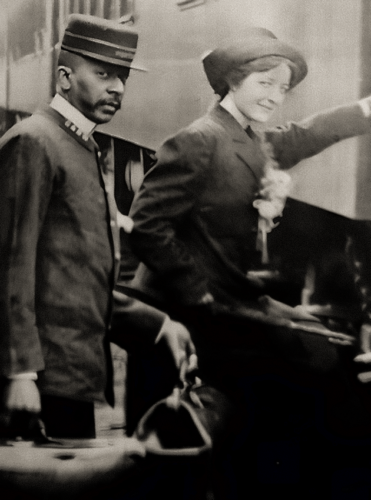
A Pullman Porter assisting a passenger with her luggage.
The Daily Lives of the Porters
Life as a Pullman porter consisted of constant harassment from customers you could not escape from, long hours for weeks on end, cramped and uncomfortable sleeping conditions and long periods away from home. It also meant camaraderie with your fellow workers, respect from your community members, and enough excess income to send your children to college.
At the George Pullman Company, each Pullman car had one porter assigned to it. That porter attended to the needs of each individual rider in his car. These responsibilities included making and turning down the beds each night, answering questions, carrying luggage, running meal and drink requests to the cooks, ironing clothes, and being an ear for lonely passengers.

Porter with Child Publicity Photo, circa 1940s. Museum of American Railroad
Porters worked long and hard hours for minimal pay, often putting in 400 hours or traveling 11,000 miles each month to receive full pay. In the 1900s, Pullman hired 10,000 porters and maids, most from the South.
Porters experienced constant racist treatment from customers, referred to, not by name, but by "boy" or "George", a remnant of slavery when enslaved people were called their slaveowner’s name. Some Black individuals viewed them negatively as grinning "Uncle Toms" due to the deferential role they were forced to play for tips. This racial degradation was built into the foundation of the job itself. George Pullman knew being a porter was better work than sharecropping1, so he could pay his porters less and they would accept harsher treatment.
Black men were excluded from the American Railway Union, so had no organization to advocate for themselves. George Pullman also wanted a group of workers that would act as an "invisible" labor source, someone who would be regarded as "part of the furnishing rather than a mortal with likes, dislikes, and a memory."2 For White travelers, that was Black men.

Silver gelatin print is a promotional photograph from the 1935 educational short film "A Journey by Train," produced by Text Film Corp, 1935.
George Pullman also employed Black women as Pullman maids. These women worked mainly in the women’s cars. They held the lowest rank among Pullman employees, deferring to White conductors and Pullman porters. Pullman maids had the same duties as porters. In addition, they cared for children and sick passengers, mended clothes, pressed garments, and provided hair care and makeup for the White women on board. Like the porters, Pullman maids faced racist treatment. They also experienced sexual harassment from male passengers and conductors – with no avenues for justice.
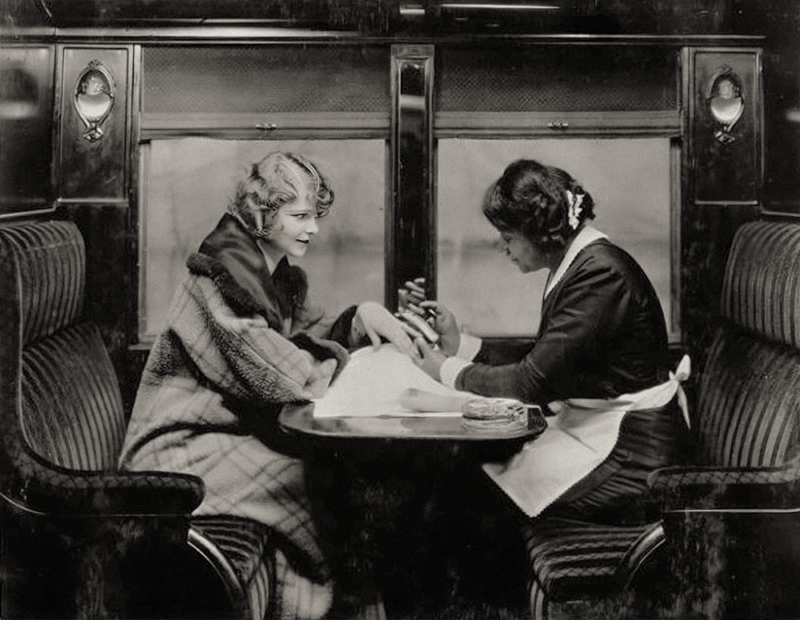
Pullman Maid providing a manicure to a passenger inside a first-class train compartment. Circa 1929.
Despite the poor treatment on board, porter jobs were highly competitive. A porter’s job was a prestigious one, offering better wages than tenant farming and agricultural work, or the more dangerous urban jobs in steel factories and meatpacking houses. A job as a porter looked great on job applications due to the high expectations and conduct expected of porters.
Porters viewed George Pullman as a man of contradictions. The Pullman Company was the single largest employer of Black men in America. Pullman paid them a low wage, but he offered one of the only opportunities for African Americans to climb into the lower-middle-class. George Pullman was known for his complete disregard for workers. At the time, it was said that George did not care if you were White or Black, he only cared that you could make him money.
Black Culture
Pullman porters played a major role in advancing Black culture in America. Pullman cars crossed America with stops at almost every major city. When Pullman cars stopped overnight, porters ventured into the local segregated Black communities to find places to spend the night, as well as restaurants and entertainment venues that would serve them. These well-traveled porters tasted Black culture across the United States and carried those experiences and connections back home and from town to town. They observed the differences between how Black communities were oppressed in urban and rural areas and across the North and South.
Porters also literally acted as reporters, carrying Black newspapers like the Chicago Defender across the United States. Porters would pick up the paper in Chicago and throw stacks off the back of the train as it ran through Black neighborhoods. This newspaper was incredibly important for Black communities across the United States, particularly for those migrating out of the South. The newspaper carried classified advertisements offering jobs, transportation, and housing in the North. The Chicago Defender was such a threat to cheap Southern labor that towns banned the distribution of the paper. Porters risked their livelihoods and their lives to spread this critical resource.
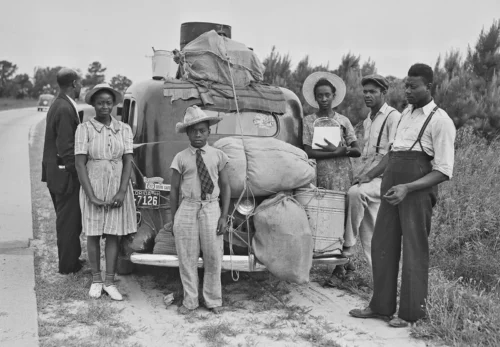
An Black family preparing to leave North Carolina for New Jersey in 1940, during the Great Migration.
The Great Migration
The Great Migration was the movement of approximately 6 million African Americans from the rural South to cities in the Northeast, Midwest, and West from 1910 to 1970. It was the largest internal migration in American history. Porters told Black communities how to travel across America and what they might find in Northern cities. Many became determined to escape racial violence in the Jim Crow South and pursue educational and economic opportunities in the North.
This journey was a long, hard one for Black families. They left everything they knew behind for the chance of a better future. This exodus of African Americans threatened the economic foundations of the South. Southern authorities tried to stop it. They detained individuals and families at railroad platforms until they missed their trains or packed them into Jim Crow cars (segregated cars with no amenities).
Pullman cars themselves were an important resource for the Black travelers who could afford them. By paying more for a Pullman car, Black passengers could ensure their safety, as the cars were designed with more privacy, insulating passengers from hostile or violent White individuals. Cars were mainly racially segregated; there were just a few integrated cars in the North. On the segregated cars Black passengers had access to the “berths” and some privacy, which limited harassment from White rail line workers and conductors.
The Black Middle Class

Porter Omer Ester & his wife Jean. circa 1925-1930.
Porter jobs were highly sought after by Black men as an opportunity to advance their economic status.
Despite the poor treatment and long hours, porters made around $810 per year in 1926.3 This amount increased to around $1,200 with the first wage increase agreed to between their newly-formed union and the company.4
This was much more than the median income for Black workers at the time. This income, plus the tips they received on the job, brought a new generation of Black children into the middle class.5
On the rail, porters got a firsthand look at the lives of wealthier Americans, which pushed them to advocate for the importance of their and their children’s economic rights and access to education. Porters used any excess wages to fund their children’s education, sending them to HBCUs.6 This next generation of Black children, who grew up seeking higher education on the funds of their father’s porter paychecks, helped form the nation’s growing Black professional class. Many influential Black individuals from the mid 1900s had porter connections, either through their fathers or working as a porter themselves. For example, the first Black Supreme Court Justice, Thurgood Marshall, worked as a porter. So did the first Black American filmmaker, Oscar Micheaux, and Matthew Henson, the Black explorer who co-discovered the North Pole.
US museums that feature Pullman cars in their collections that visitors may view or walk through:
- National Railroad Museum (Green Bay, WI): Features the "Lake Mitchell" 1920s Pullman sleeper car as part of its "Pullman Porters: From Service to Civil Rights" exhibit.
- Illinois Railway Museum (Union, IL): Known for having an extensive collection that includes cars such as the Pullman "Villa Real," "Villa Falls," and "Palm Lane".
- B&O Railroad Museum (Baltimore, MD): Displays the Pullman "Washington" Observation Tavern Car and a Pullman diner.
- Museum of the American Railroad (Frisco, TX): Houses a collection of Pullman cars, including the "Glen Nevis," a 6-3 sleeper.
- Tennessee Valley Railroad Museum (Chattanooga, TN): Features Pullman cars that highlight the history of luxury rail travel.
- Gold Coast Railroad Museum (Miami, FL): Features various passenger cars, including the SAL #259. [1]
- Southeastern Railway Museum (Duluth, GA): Houses the Norfolk Southern 10-6 sleeper "Tugalo River," built by Pullman Standard. [1]
- Monticello Railway Museum (Monticello, IL): Displays a 1918 Pullman-built railway post office car. [1]
- National A. Philip Randolph Pullman Porter Museum (Chicago, IL): Focuses on the history of the Pullman porters and African-American labor history. [1, 2]
- Pullman National Historical Park (Chicago, IL): Located at the former Pullman factory site, offering tours of the grounds and administration building
Footnotes
Arnesen, Eric. 2002. Brotherhoods of Color: Black Railroad Workers and the Struggle for Equality. N.p.: Harvard University Press.
“The Great Migration (1910-1970).” 2021. National Archives. https://www.archives.gov/research/african-americans/migrations/great-migration.
Holbrook, Stewart H. 1947. “The Life of a Pullman Porter.” In Instructions to Porters, Attendants, and Bus Boys. New York: Crown Publishers Inc.
Tye, Larry. 2005. Rising from the Rails: Pullman Porters and the Making of the Black Middle Class. N.p.: Henry Holt and Company.
X, Malcolm. 1973. The Autobiography of Malcolm X. Edited by Alex Haley. N.p.: Random House Publishing Group. InternetArchive.
1Sharecropping is a legal arrangement in which a landowner allows a farmer to live and raise crops on the landowner’s land in return for a share of those crops. The landowner provides the seed, supplies, animals, and tools—and usually sets the price he will pay for his portion of the crops, minus his charges for the seeds, supplies and equipment used. Often sharecroppers were charged more than they earned, so the system kept them in perpetual debt to the landowner. Sharecropping is different from tenant farming, which provides the tenant greater autonomy and higher economic and social status.
2Tye, Rising From the Rails, 2005.
3Arnesen, Brotherhoods of Color, 2002. $810 is equal to about $15,000 when calculated for inflation as of March 2026.
4Holbrook, “The Life of a Pullman Porter”, 1947. Around $22,000 when calculated for inflation as of March 2026.
5Holbrook, Tips were reported at an average of $100 a month
6An HBCU is a “Historically Black College or University.”
Eleanor Olbinski is a scholar and graduate of Queen’s University’s Master’s of History Program in Belfast, Northern Ireland. She has contributed research at the National Railroad Museum, the Sun Prairie Historical Museum, the Brown County Historical Society, the Hazelwood House, the Generations of Freedom Project, and the ABHM. Her research focuses on the symbiotic relationship between race and culture in the Reconstruction Era. Her work aims to highlight how racial injustice pervades daily interactions and bring to light moments of history previously ignored.