This Date in History: The Washington Bee Newspaper is Published
Share
Explore Our Galleries









Breaking News!
Today's news and culture by Black and other reporters in the Black and mainstream media.
Ways to Support ABHM?
From The African American Registry
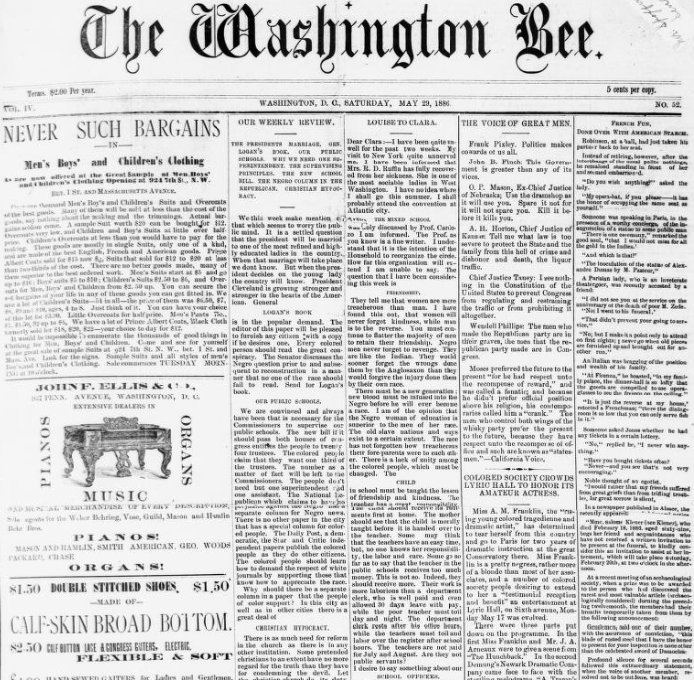
The Washington Bee was founded on this date in 1882. It was a Washington, D.C.-based American weekly newspaper primarily catering to and read by Blacks.
Throughout almost all of its 40 years in publication, it was edited by Black lawyer-journalist William Calvin Chase. The Bee’s publication history coincided with a two-generation period of American history during which the politically reactionary Redeemers sharply constrained the political roles of Blacks. Successful professional Black individuals, such as editor Chase, faced constant political battles to maintain the limited gains made in previous generations. Chase’s editorials initially criticized accommodating Black leaders, such as Booker T. Washington, but later made peace with the influential Tuskegee leader.
The Bee shared the Washington, D.C. market with a rival weekly, the Colored American. Washington’s private papers indicate that he and his network financially supported both news sheets. The Bee’s nameplate slogan was “Sting for Our Enemies – Honey for Our Friends,” and according to a Library of Congress critic, “the Bee represented the Republican attitudes of its editor, although Chase did not hesitate to criticize Republican Party leaders when he thought they were on the wrong side of an issue.” The Bee′s circulation numbers are unknown but were never large; the highest figure given is 9,700 in 1922.
That was the year the Bee ceased publication, unable to survive the death of its editor in 1921.
Read more about this historic newspaper.
Comments Are Welcome
Note: We moderate submissions in order to create a space for meaningful dialogue, a space where museum visitors – adults and youth –– can exchange informed, thoughtful, and relevant comments that add value to our exhibits.
Racial slurs, personal attacks, obscenity, profanity, and SHOUTING do not meet the above standard. Such comments are posted in the exhibit Hateful Speech. Commercial promotions, impersonations, and incoherent comments likewise fail to meet our goals, so will not be posted. Submissions longer than 120 words will be shortened.
See our full Comments Policy here.