The NAACP Develops an HIV Manual for Black Churches
Share
Explore Our Galleries









Breaking News!
Today's news and culture by Black and other reporters in the Black and mainstream media.
Ways to Support ABHM?
From NAACP
About NAACP’s Commitment to HIV/AIDS as a Social Justice Issue
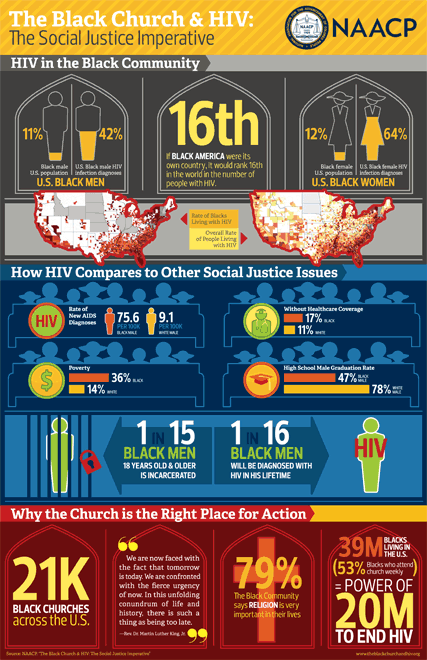
Throughout our history, the NAACP has fought to combat policies and practices that undermine human rights and social justice. HIV is now one of these important issues for our community. Black people are more likely to become infected, less likely to know they have the disease and more likely to die from HIV/AIDS than any other race.
Based on this belief, the NAACP conducted a year-long, 11-city research tour with over 250 faith leaders across denominations to identify best practices and challenges when addressing HIV within the Black Church. With this collected research and insight from the HIV manual advisory committee, we developed The Black Church and HIV: The Social Justice Imperative.
Read more about this initiative here. Download the Manual and/or the Pastoral Brief here.
Efforts like this cannot overlook HIV among Black women.
Comments Are Welcome
Note: We moderate submissions in order to create a space for meaningful dialogue, a space where museum visitors – adults and youth –– can exchange informed, thoughtful, and relevant comments that add value to our exhibits.
Racial slurs, personal attacks, obscenity, profanity, and SHOUTING do not meet the above standard. Such comments are posted in the exhibit Hateful Speech. Commercial promotions, impersonations, and incoherent comments likewise fail to meet our goals, so will not be posted. Submissions longer than 120 words will be shortened.
See our full Comments Policy here.