America’s first Black U.S. attorney general endorses Keisha Lance Bottoms as redistricting battles reshape the South
Share
Explore Our Galleries









Breaking News!
Today's news and culture by Black and other reporters in the Black and mainstream media.
Ways to Support ABHM?
Zachary Bynum, CBS News
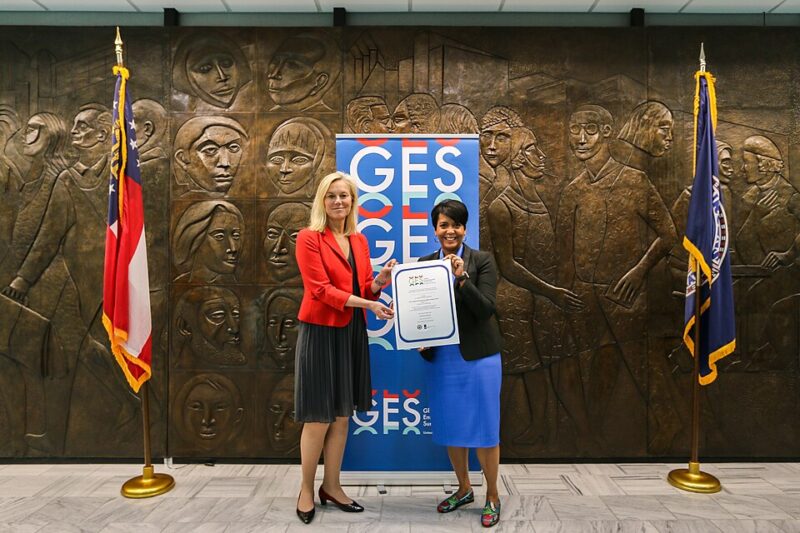
Netherlands Embassy, CC BY 2.0, via Wikimedia Commons)
Former U.S. Attorney General Eric Holder, the nation’s first Black attorney general, has endorsed Democratic gubernatorial candidate Keisha Lance Bottoms, lending one of the Democratic Party’s most recognizable voices on voting rights and redistricting to Georgia’s closely watched governor’s race.
The endorsement arrives as legal battles over redistricting continue to reshape the political landscape across the South, where several states have redrawn congressional maps while others, including Georgia, remain the focus of ongoing arguments over how political boundaries should be drawn in the years ahead.
“The race by Republicans across the country to manipulate maps in their party’s favor and do real-world damage to the everyday lives of Americans is not over, and in the 2026 midterms, Georgians have a chance to fight back at the ballot box by electing leaders who will protect against egregious partisan and racial gerrymanders in the Peach State,” said Holder Jr., the country’s 82nd Attorney General in a released statement.
Holder — who served as attorney general under President Barack Obama and held senior positions in the Justice Department under Presidents Clinton and Reagan, and later founded the National Democratic Redistricting Committee — has been an outspoken critic of the U.S. Supreme Court’s decision in Louisiana v. Callais. The ruling held that race cannot be the predominant factor in drawing congressional districts without satisfying strict constitutional requirements, a decision that has already begun reshaping redistricting efforts nationwide.
Critics argue the ruling weakens protections that have historically allowed race to be considered when complying with the Voting Rights Act.
Bottoms has previously supported Atlanta’s Public Safety Training Center, which earned the city the nickname “Cop City.”
Follow political races that impact Black Americans in our Breaking News section.
Comments Are Welcome
Note: We moderate submissions in order to create a space for meaningful dialogue, a space where museum visitors – adults and youth –– can exchange informed, thoughtful, and relevant comments that add value to our exhibits.
Racial slurs, personal attacks, obscenity, profanity, and SHOUTING do not meet the above standard. Such comments are posted in the exhibit Hateful Speech. Commercial promotions, impersonations, and incoherent comments likewise fail to meet our goals, so will not be posted. Submissions longer than 120 words will be shortened.
See our full Comments Policy here.