Sirens Failed. FEMA Didn’t Show Up. Now Black St. Louis Recovers from Deadly Tornadoes Alone.
Share
Explore Our Galleries









Breaking News!
Today's news and culture by Black and other reporters in the Black and mainstream media.
Ways to Support ABHM?
by Adam Mahoney, CapitalB
Just weeks before, Trump slashed nearly $1B in disaster aid meant for Black and low-income neighborhoods.
The sky turned an eerie green over St. Louis on May 16.
Rapper and activist Antoine White, better known as T-Dubb-O, recognized the ominous hue immediately. Having family in the heart of Tornado Alley in Tennessee, he knew what was coming. With his wife and son beside him after a school field day lunch in Clayton, a suburb of St. Louis, he made the split-second decision to flee north, away from the city. Even though a tornado hadn’t hit the city in two generations, he didn’t want to risk it.
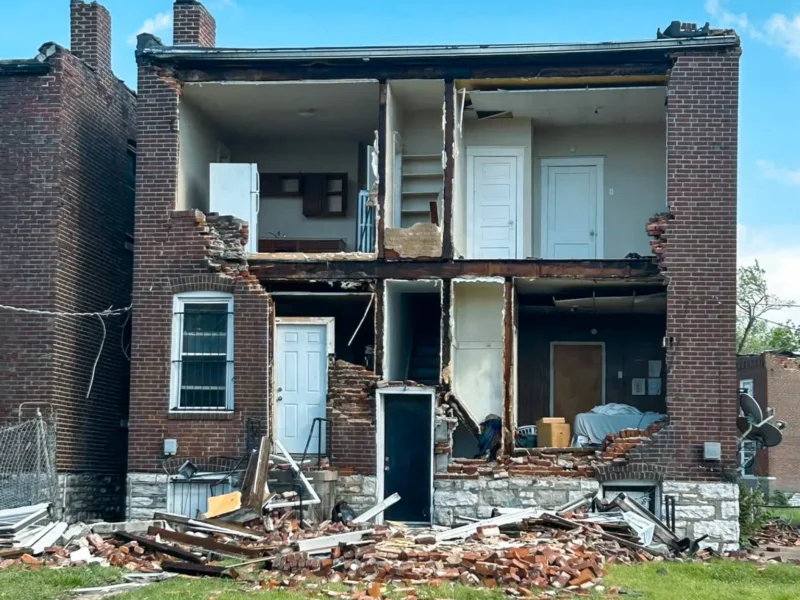
No tornado sirens wailed and no emergency alert pinged on his wife’s phone. But as White’s car barreled through gridlocked traffic, behind them, an EF-3 tornado carved a 12-mile scar through the area’s Black neighborhoods. Its 150 mph winds peeled roofs from schools and homes where many residents lacked basements to hide. Five victims — including three children — died in collapsed buildings that a responsive alert system might have evacuated. Generational Black businesses like The Harlem Tap Room and thousands of buildings were damaged or destroyed.
In total, across Missouri and Kentucky, the system of tornadoes left at least 27 people dead over the weekend and dozens of people trapped and injured in their homes. It comes just two months after at least 42 people lost their lives to a tornado system across eight states in March, with the most deaths occurring in Missouri and Mississippi.
In these storms’ wake, a brutal truth is emerging for Black residents: The nation’s emergency systems — from crumbling siren alerts to gutted federal programs — have left its most vulnerable residents dangerously exposed. From last year’s Hurricane Helene to this year’s wildfires, America’s emergency alert and disaster preparedness system isn’t keeping up.
Learn how the Black community in St Louis has been impacted by tornadoes amidst government changes.
Redlining often forced Black residents to give up their land and move to certain areas with fewer resources.
Comments Are Welcome
Note: We moderate submissions in order to create a space for meaningful dialogue, a space where museum visitors – adults and youth –– can exchange informed, thoughtful, and relevant comments that add value to our exhibits.
Racial slurs, personal attacks, obscenity, profanity, and SHOUTING do not meet the above standard. Such comments are posted in the exhibit Hateful Speech. Commercial promotions, impersonations, and incoherent comments likewise fail to meet our goals, so will not be posted. Submissions longer than 120 words will be shortened.
See our full Comments Policy here.