Maryland’s Forgotten Victims: Shedding Light on the State’s Lynching Legacy
Share
Explore Our Galleries









Breaking News!
Today's news and culture by Black and other reporters in the Black and mainstream media.
Ways to Support ABHM?
By THE AFRO Megan Sayles
Maryland is the first state in the U.S. to establish a commission focused solely on investigating its horrific lynching past.
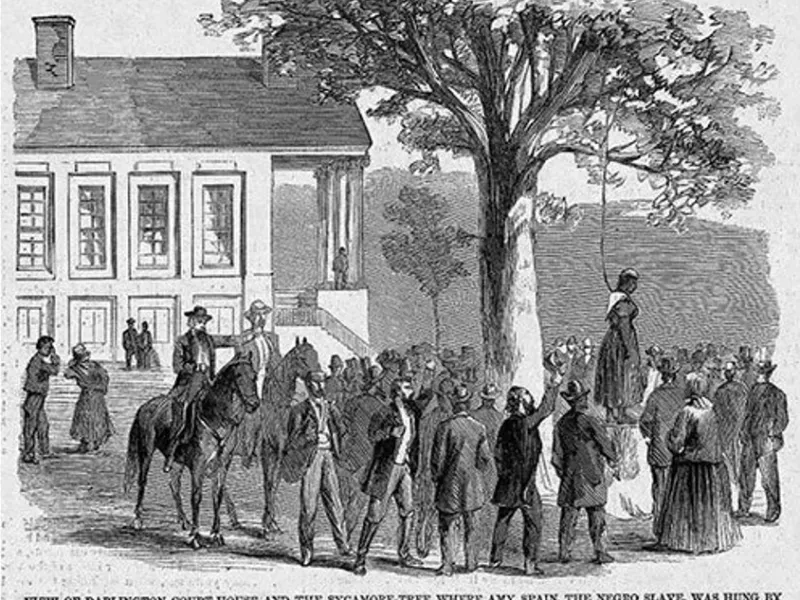
The Maryland Lynching Memorial Project (MLMP) was established in 2018 to document the state’s history of racial terror lynchings and call for the public acknowledgment of the brutal killings that were historically public spectacles. Since then, the organization has helped to identify 38 African Americans who were lynched in Maryland between 1854 and 1933. No one was ever held responsible for their deaths.
The MLMP’s truth-telling mission seeks to open the door to reconciliation and healing for not only the descendants of these victims but also the broader Black community.
“If there’s going to be justice, there has to be truth,” said Nicholas Creary, vice president of the MLMP. “It’s all about trying to create a better present and future, but we have to be able to use and access the past to create the future we want.”
The MLMP’s mission has become even more critical in light of the growing attacks on Black history and equity, diversity and inclusion.
In March, the 47th president signed an executive order that seeks to censor Smithsonian exhibits on race and identity. States like Florida, Texas and South Carolina have also prohibited the teaching of critical race theory (CRT) and banned a number of Black books.
“Now, more than ever, we need to have organizations like this crying out and seeking justice, especially as the current administration in Washington and a lot of other places are working really hard to erase and subvert that history,” said Creary.
By sanitizing history to celebrate progress while suppressing stories of oppression, systems that created injustice can be reinforced.
“It doesn’t make sense to talk about these great African-American firsts if we don’t understand the history of racism, segregation and discrimination and how they continue to play out,” said Creary. “A lot of those practices are ongoing. The ongoing police violence against Black communities nationwide is a form of modern-day lynching. Oppression doesn’t end, it’s only adapted.”
Read more on Maryland Lynching Legacy and the Forgotten Victims
Check out our Special Exhibits A Memorial to the Victims of Lynching
Check out our Breaking News section for more Black News.
Comments Are Welcome
Note: We moderate submissions in order to create a space for meaningful dialogue, a space where museum visitors – adults and youth –– can exchange informed, thoughtful, and relevant comments that add value to our exhibits.
Racial slurs, personal attacks, obscenity, profanity, and SHOUTING do not meet the above standard. Such comments are posted in the exhibit Hateful Speech. Commercial promotions, impersonations, and incoherent comments likewise fail to meet our goals, so will not be posted. Submissions longer than 120 words will be shortened.
See our full Comments Policy here.