Florida’s 6-week abortion ban will disproportionately impact Latina and Black women, advocates say
Share
Explore Our Galleries









Breaking News!
Today's news and culture by Black and other reporters in the Black and mainstream media.
Ways to Support ABHM?
By By Nicole Acevedo, NBC News
The law signed by Gov. Ron DeSantis will take effect only if Florida’s current 15-week ban is upheld in an ongoing legal challenge that is before the state Supreme Court.
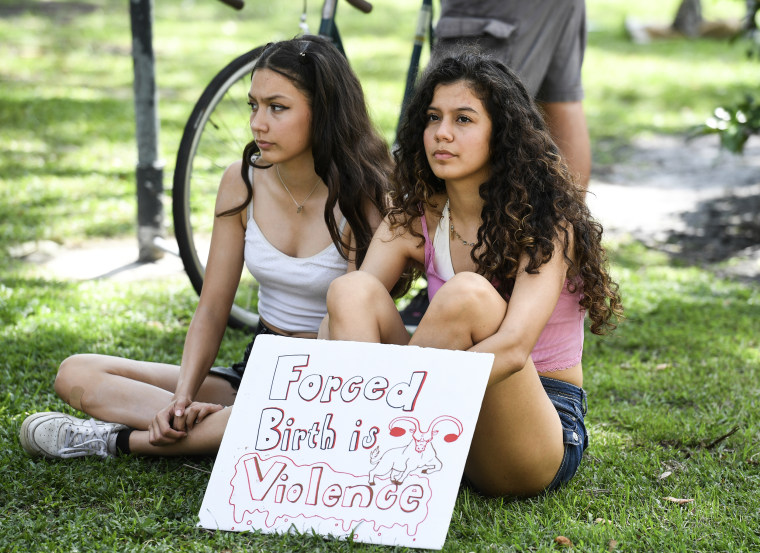
Advocates worry the Florida’s new law would result in more people of color being forced to carry unwanted pregnancies to term
Thursday was a sad day for Floridians like Estefany Londoño, who have long advocated for abortion rights in their home state, as the possibility of a six-week abortion ban going into effect later this year started to sink in.
“It’s heartbreaking,” Londoño, 26, said. “People should be able to make those decisions when they’re ready and not because they’re forced into certain situations.”
Latinas and Black women working to keep abortions accessible in Florida worry the new law will result in more people of color being forced to carry unwanted pregnancies to term — which often results in worse economic and mental health outcomes.
While women of reproductive age of all races and ethnicities are at risk of unintended pregnancy, Hispanic and Black women face a disproportionally higher risk, according to research published in 2020 in the peer-reviewed journal Contraception and Reproductive Medicine.
“The conditions of our state, people not being able to afford abortion care, these are going to keep people pregnant against their will, ultimately,” Florida Access Network co-executive director Stephanie Loraine Piñeiro, who heads the only abortion fund led by queer people of color in the state, said.
The law signed by Gov. Ron DeSantis Thursday night will take effect only if Florida’s current 15-week ban is upheld in an ongoing legal challenge that is before the state Supreme Court.
Bienvenido US, a Hispanic conservative national group, celebrated the news on Friday calling it “A PRO LIFE VICTORY!” on Twitter. The Radiance Foundation, a faith-based nonprofit group founded by African American anti-abortion rights activist Ryan Bomberger, shared a post on Facebook celebrating the abortion ban saying, “We won’t stop this #humanrights fight until every life is protected from the violence of abortion and the predators who profit from fear and pain.”
Florida is home to 828,100 Black women of reproductive age. Among the 1.4 million Latinas of reproductive age, 570,000 are economically insecure and 585,200 are already mothers, according to a November report.
For Black and brown people in the state, giving birth can present an additional set of dangers and concerns given its high rates of maternal mortality.
Some also face systemic barriers such as lack of heath insurance, health care literacy and access to culturally and linguistically competent health systems, as well as “discriminatory policies that make it difficult for people to access routine health care,” Aurelie Colón-Larrauri, the Florida state policy advocate for the National Latina Institute for Reproductive Justice, said.
“Forcing anyone in marginalized communities to continue their pregnancy, because they cannot terminate them, may actually contribute to an increase of maternal mortality rates in the state of Florida,” Colón-Larrauri said.

Gov. Ron DeSantis signs 6-week Florida abortion ban amid presidential speculation
Colón-Larrauri and Piñero worry about how many people will forgo abortion care because they can’t travel or afford the procedure.
“This six-week abortion ban is effectively a total ban,” Piñero said, adding that it’s often not enough time for people to find out they are pregnant, figure out how to pay for the procedure, secure traveling and lodging logistics, and in some cases child care.
“It’s not realistic, and that’s by design,” she added.
A recent Turnaway Study from demographer Diana Greene Foster, a professor of obstetrics, gynecology and reproductive sciences at the University of California San Francisco, found that women who had been denied abortion access experienced worse economic and mental health outcomes than women who had received care and that 95% of study participants who received abortions said they made the right decision.
Click here to read the whole article and see additional context
To find out about how abortion band disproportionally impact people of color, Click here
Visit the BHM exhibit on Racial Repair and Reconciliation to find out ways that we as people and as a society can work to put an end to racial inequality
Comments Are Welcome
Note: We moderate submissions in order to create a space for meaningful dialogue, a space where museum visitors – adults and youth –– can exchange informed, thoughtful, and relevant comments that add value to our exhibits.
Racial slurs, personal attacks, obscenity, profanity, and SHOUTING do not meet the above standard. Such comments are posted in the exhibit Hateful Speech. Commercial promotions, impersonations, and incoherent comments likewise fail to meet our goals, so will not be posted. Submissions longer than 120 words will be shortened.
See our full Comments Policy here.