How Milwaukee residents and civil rights activists pushed Milwaukee Public Schools to desegregate
Share
Explore Our Galleries









Breaking News!
Today's news and culture by Black and other reporters in the Black and mainstream media.
Ways to Support ABHM?
Alex Klaus and Hongyu Liu, Wisconsin Watch
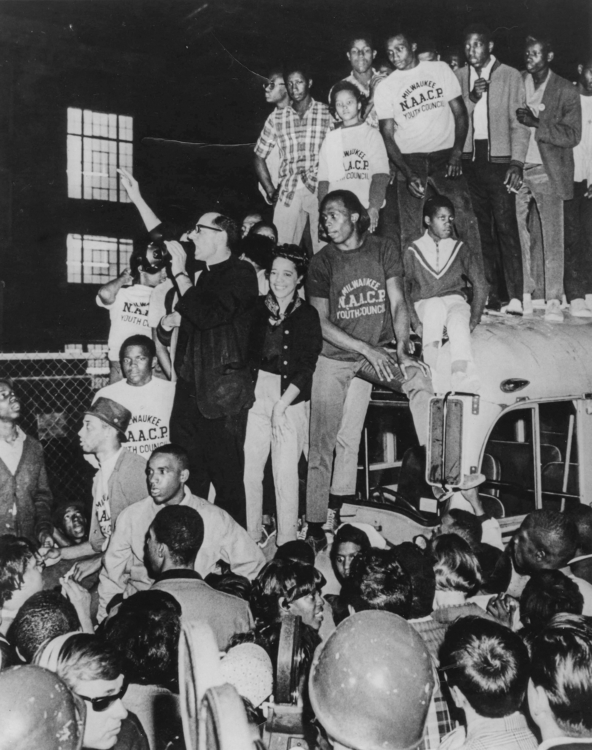
A year of protests against school segregation wasn’t enough to sway Milwaukee Public Schools to integrate. So in 1965, Milwaukee attorney and National Association for the Advancement of Colored People (NAACP) leader Lloyd Barbee filed a lawsuit against the district, arguing it intentionally took action to keep schools segregated.
Racially restrictive covenants and redlining already legally maintained neighborhood segregation in the city, University of Wisconsin-Milwaukee urban studies professor Anne Bonds said.
“In a dynamic where you have a deeply segregated landscape and a housing landscape that’s been produced by design … the schools that children would attend in their racially segregated neighborhoods would reflect the patterns of racial segregation that exist,” Bonds said.
After ten years of fighting, federal judge John Reynolds ruled on Jan. 19, 1976, that Milwaukee Public Schools needed to take action to desegregate their schools. But how did they get there?
Head over to the original article to see an interactive timeline of the three decades of activism that led to desegregation in Milwaukee.
Learn more about the fight for civil rights and how the federal government is no longer supporting desegregation the way it did.
Discover more Black history news.
Comments Are Welcome
Note: We moderate submissions in order to create a space for meaningful dialogue, a space where museum visitors – adults and youth –– can exchange informed, thoughtful, and relevant comments that add value to our exhibits.
Racial slurs, personal attacks, obscenity, profanity, and SHOUTING do not meet the above standard. Such comments are posted in the exhibit Hateful Speech. Commercial promotions, impersonations, and incoherent comments likewise fail to meet our goals, so will not be posted. Submissions longer than 120 words will be shortened.
See our full Comments Policy here.