Becoming the Civil Rights Queen
Share
Explore Our Galleries









Breaking News!
Today's news and culture by Black and other reporters in the Black and mainstream media.
Ways to Support ABHM?
From PBS
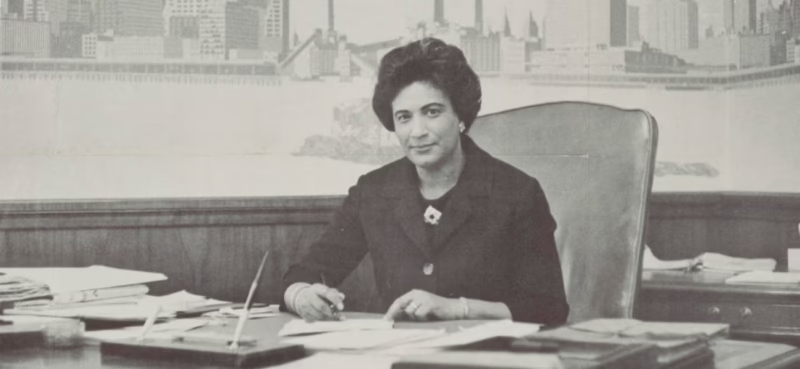
How does one earn the moniker of “Civil Rights Queen”? For Constance Baker Motley, the journey began in New Haven, Connecticut in 1921, as the daughter of immigrants from Nevis (yes, the same Caribbean island that produced Alexander Hamilton). After graduating from NYU and Columbia Law School, Motley got her big break when Thurgood Marshall hired her as staff attorney for the NAACP’s Legal Defense Fund. The future Supreme Court justice later remarked that his new protegée “just walked in and took over,” marking the start of an audacious six-decade-long legal career.
When Motley first entered the courtroom in the late 1940s, it was rare enough to see a female lawyer or a Black lawyer, let alone one who inhabited both identities. White judges and lawyers often refused to address her with the proper honorific, referring to her as “that Motley woman” or “her.” On one occasion, Constance Baker Motley corrected her opposing counsel: “If you can’t address me as Mrs. Motley, don’t address me at all.”
During her tenure with the NAACP, Motley authored the original complaint for Brown v. Board of Education, the landmark case that ended legal school segregation in the United States. But she didn’t just write briefs — Motley took to the front lines of the fight against segregation, leading the legal charge to desegregate public universities across the South — including the case that won James Meredith’s historic admission to the University of Mississippi.
The first Black woman to argue before the Supreme Court, she won nine of her 10 cases, challenging segregation and defending the right to practice civil disobedience. She also provided critical legal support for Dr. Martin Luther King Jr., the Freedom Riders, and the young protesters of the Birmingham Children’s Crusade — all while fighting her own battles against discrimination and pay equity as a Black woman in the American workplace.
Continue reading about her efforts outside of the courtroom or watch a video about Motley.
Learn about other activists and social movements.
Follow more stories like this all month long in our breaking news.
Comments Are Welcome
Note: We moderate submissions in order to create a space for meaningful dialogue, a space where museum visitors – adults and youth –– can exchange informed, thoughtful, and relevant comments that add value to our exhibits.
Racial slurs, personal attacks, obscenity, profanity, and SHOUTING do not meet the above standard. Such comments are posted in the exhibit Hateful Speech. Commercial promotions, impersonations, and incoherent comments likewise fail to meet our goals, so will not be posted. Submissions longer than 120 words will be shortened.
See our full Comments Policy here.