Critics say the movement to defund the police failed. But Austin and Seattle are seeing progress
Share
Explore Our Galleries









Breaking News!
Today's news and culture by Black and other reporters in the Black and mainstream media.
Ways to Support ABHM?
By Melissa Hellmann, The Guardian
The rallying cry from 2020 Black Lives Matter protests pushed some US cities to divert money towards housing and community services
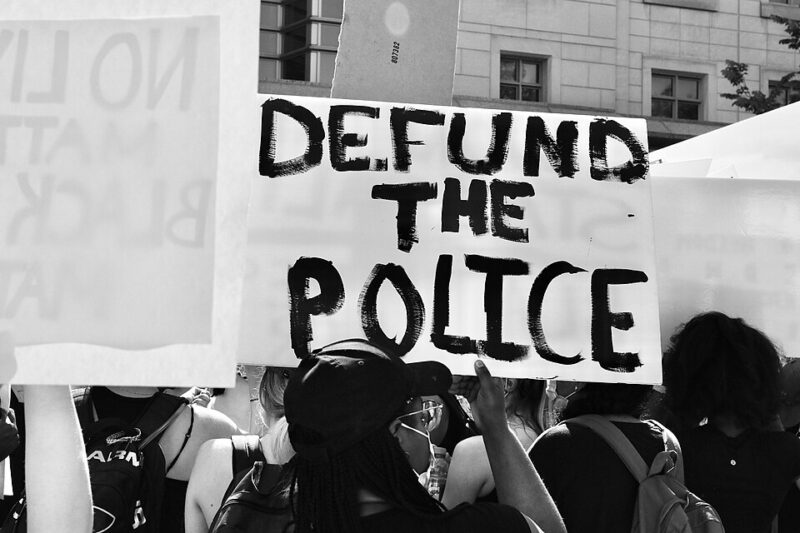

Taymaz Valley, CC BY 2.0, via Wikimedia Commons)
After George Floyd’s murder by a Minneapolis police officer in 2020, protesters who swarmed the streets across the US shouted the refrain: “Defund the police.” An idea that was once viewed as radical – to redirect money from law enforcement to other city departments and social services – became a rallying cry overnight.
As a result of continued pressure, dozens of jurisdictions throughout the nation promised to reduce their police budgets. While most of them backtracked and increased law enforcement funding in the next year or two, several cities changed policies or added new public safety and homeless services departments.
Milwaukee is one city where leaders diverted money to social programs that had a lasting impact: funding from the police department went toward affordable housing and youth programming. After 2020, Seattle invested part of its police funding into participatory budgeting, a process in which the public votes on how to spend a portion of the city’s finances.
A few years later, inspired by calls for alternatives to policing from Black and brown organizers, Seattle leaders launched a third public safety department that responds to mental health crises. And Austin has increasingly invested more money in its homeless services since the city diverted millions of dollars from the 2021 police budget to go toward permanent supportive housing instead.
Political organizers the Guardian spoke to said the abolitionist dream of divesting from police and reinvesting in social services is a long journey full of valleys. Backlash followed the 2020 protests, and public sentiment toward the movement quickly shifted.
[…]
Though the success stories of the defund movement are not always clear, the groups behind it say they helped move the needle forward in sparking conversations about city priorities and reimagining what public safety looks like.
[…]
“If spending money on policing were an effective way to deter crime, then the United States would be the safest country on the planet that has ever existed and it is nowhere near that,” said Marcus Board, an associate professor of political science at Howard University. “Meanwhile, healthcare suffers, childcare suffers, elder care suffers, public spaces are going away.”
The police play an integral role in, often justified by the so-called war on drugs.
Comments Are Welcome
Note: We moderate submissions in order to create a space for meaningful dialogue, a space where museum visitors – adults and youth –– can exchange informed, thoughtful, and relevant comments that add value to our exhibits.
Racial slurs, personal attacks, obscenity, profanity, and SHOUTING do not meet the above standard. Such comments are posted in the exhibit Hateful Speech. Commercial promotions, impersonations, and incoherent comments likewise fail to meet our goals, so will not be posted. Submissions longer than 120 words will be shortened.
See our full Comments Policy here.