‘Art Against the Odds’ Shines a Light on Artists Within Wisconsin’s Justice System
Share
Explore Our Galleries









Breaking News!
Today's news and culture by Black and other reporters in the Black and mainstream media.
Ways to Support ABHM?
By Kate Mothes, Arts Midwest
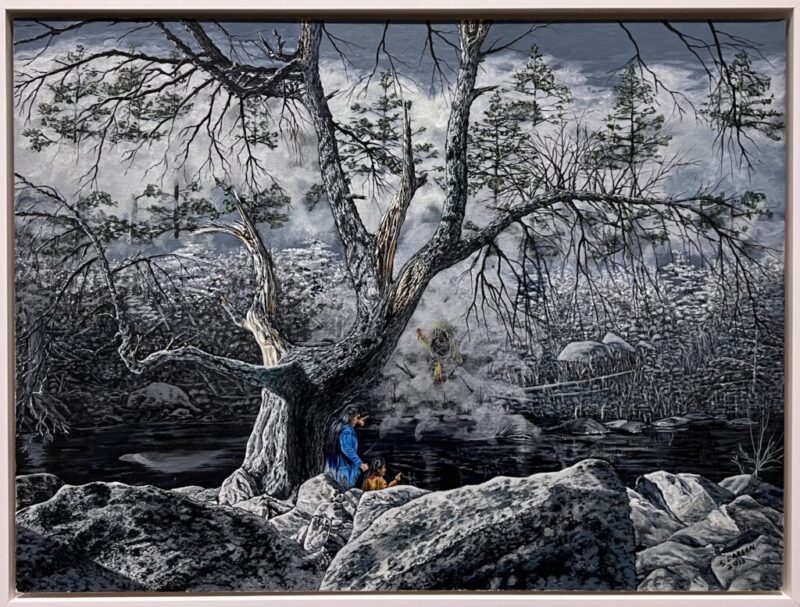
In a self-portrait titled “First Aid Kit” by DarRen Morris painted in 2019, the artist clutches a large, abstract object with fanned white bristles. At first difficult to recognize, the object in his arms is a giant paintbrush. Incarcerated within the Wisconsin Correctional System since the age of 17 and serving a life sentence, Morris clings to art as a survival tool, emphasizing that without it, he would not be able to endure the conditions of imprisonment.
“Art Against the Odds: Wisconsin Prison Art defines art making as not only a creative pastime but a life-saving tool of self-definition for those who are removed from society,” opens the preface of the exhibition’s catalog. The wide-ranging group exhibition, most recently on view at the Neville Public Museum in Green Bay, Wisconsin, brings together work by artists incarcerated within the state’s correctional facilities as a way to counter assumptions about imprisoned individuals and the prison system itself.
Debra Brehmer, director of Portrait Society Gallery in Milwaukee, and curator of Art Against the Odds, traces the genesis of the exhibition to a very different project, yet one also focused on the impact of art-making where access to art is often scarce. The program, called On the Wing, met every Tuesday at the House of Peace, a local community center, to draw in sketchbooks.
“It was about gathering, drawing, experimenting, sharing stories, conversing, and building relationships across the divides of poverty and race,” Brehmer says. “Many conversations at the table touched on incarceration. My eyes were opened to the fact that if you are Black and poor in Milwaukee, you’ve had a friend, son, or relative in prison. It was shocking to me that this was such a normalized part of existence.”
Around this time, Brehmer began working with an incarcerated artist named M. Winston to exhibit his work in the gallery. Portrait Society works with artists who have been marginalized, ignored, dismissed, or discriminated against. “M. was a point of entry into the larger carceral world,” Brehmer says. “Exploring art made in Wisconsin prisons felt like a good COVID project, and so many inmates at that time were really suffering during lockdowns.”
Get information about the exhibit.
Our virtual special exhibits include more art.
More breaking news here.
Comments Are Welcome
Note: We moderate submissions in order to create a space for meaningful dialogue, a space where museum visitors – adults and youth –– can exchange informed, thoughtful, and relevant comments that add value to our exhibits.
Racial slurs, personal attacks, obscenity, profanity, and SHOUTING do not meet the above standard. Such comments are posted in the exhibit Hateful Speech. Commercial promotions, impersonations, and incoherent comments likewise fail to meet our goals, so will not be posted. Submissions longer than 120 words will be shortened.
See our full Comments Policy here.