Yes, You Can Measure White Privilege
Share
Explore Our Galleries









Breaking News!
Today's news and culture by Black and other reporters in the Black and mainstream media.
Ways to Support ABHM?
By Michael Harriot, theRoot.com

iStock, theRoot.com
Whenever anyone slips the words “white privilege” into a conversation, it immediately builds an impenetrable wall. For some white people, the words elicit an uneasy feeling because, for them, the term is accusatory without being specific. It is a nebulous concept that seemingly reduces the complex mishmash of history, racism and social phenomena to a nonspecific groupthink phrase.
But white privilege is real….
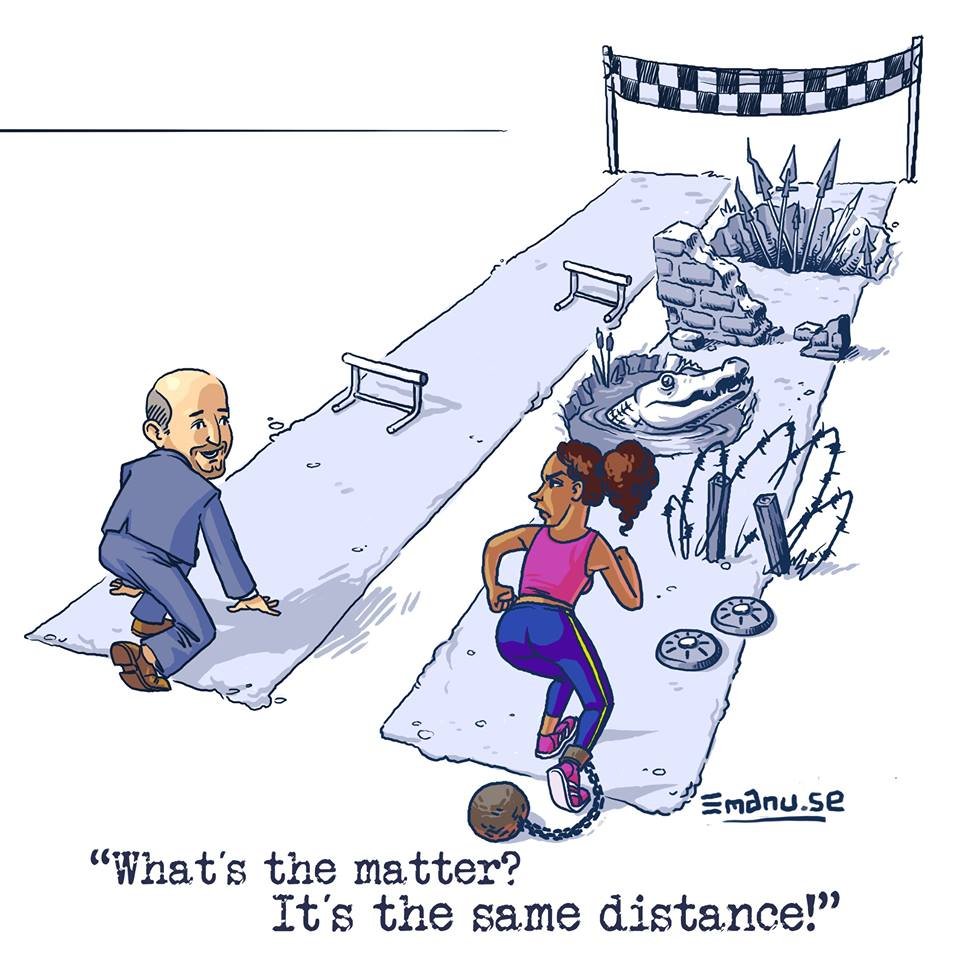 Imagine the entire history of the United States as a 500-year-old relay race, where whites began running as soon as the gun sounded, but blacks had to stay in the starting blocks until they were allowed to run. If the finish line is the same for everyone, then the time and distance advantage between the two runners is white privilege. Not only can we see it, but we can actually measure it. If we begin viewing it as an economic term—the same way we use “trickle-down economics”—then it might be debatable, but it becomes a real, definable thing that we can acknowledge, explain and work toward eliminating. Race might be a social construct, but white privilege is an economic theory that we should define as such:
White privilege: n. The quantitative advantage of whiteness
Read the full article here for four examples that explain white privilege in economic terms.
Read more Breaking News here.
Delve more deeply into white privilege in Peering Through White-Rimmed Glasses: A Letter to My Fellow White Americans here and in this annotated bibliography on whiteness.
Comments Are Welcome
Note: We moderate submissions in order to create a space for meaningful dialogue, a space where museum visitors – adults and youth –– can exchange informed, thoughtful, and relevant comments that add value to our exhibits.
Racial slurs, personal attacks, obscenity, profanity, and SHOUTING do not meet the above standard. Such comments are posted in the exhibit Hateful Speech. Commercial promotions, impersonations, and incoherent comments likewise fail to meet our goals, so will not be posted. Submissions longer than 120 words will be shortened.
See our full Comments Policy here.