Working to restore voting rights to returning citizens ahead of the general election
Share
Explore Our Galleries









Breaking News!
Today's news and culture by Black and other reporters in the Black and mainstream media.
Ways to Support ABHM?
By John Paul Taylor, Southern Poverty Law Center
As the November election draws near and demonstrations for racial justice continue to unfold across the country, it is important to remember Black people in the United States are disenfranchised from voting because of previous criminal convictions at four times the rate of all other racial groups combined. Despite recent efforts to eliminate it, we unfortunately continue to see this Jim Crow-era tactic used to suppress the voting rights of people in predominantly Black and Brown communities, especially in Louisiana, Mississippi, Alabama, Georgia and Florida, where the SPLC focuses its work….
…By passing the Definition of Moral Turpitude Act, Alabama finally clarified which felonies, state or federal, will not disqualify Alabamians from voting….
Because Alabama officials did not inform citizens of the new 2017 law, many of those affected by it were not aware that they had the right to vote. What’s more, many others who were eligible to restore their voting rights would not have been able to navigate the state’s confusing, overly bureaucratic rights restoration process without our assistance. This is something that is happening not only in Alabama, but across the country and particularly in the South….
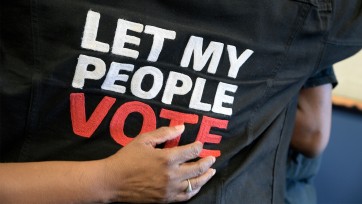
A person wearing a black shirt with the words LET MY PEOPLE VOTE.
…Many people who have previous convictions don’t trust the system – or they feel as though their vote doesn’t count. Many face day-to-day struggles that create other barriers to voting. These are compounded by the fact that communities of color have some of the lowest performing schools, lowest paying jobs, and lowest health care coverage rates….
Read the full article here.
To learn more about ways that the African American vote has been suppressed in the past and present, click here, here and here.
More Breaking News here.
Comments Are Welcome
Note: We moderate submissions in order to create a space for meaningful dialogue, a space where museum visitors – adults and youth –– can exchange informed, thoughtful, and relevant comments that add value to our exhibits.
Racial slurs, personal attacks, obscenity, profanity, and SHOUTING do not meet the above standard. Such comments are posted in the exhibit Hateful Speech. Commercial promotions, impersonations, and incoherent comments likewise fail to meet our goals, so will not be posted. Submissions longer than 120 words will be shortened.
See our full Comments Policy here.