Why Afro-Venezuelans Oppose U.S. Intervention in Venezuela
Share
Explore Our Galleries









Breaking News!
Today's news and culture by Black and other reporters in the Black and mainstream media.
Ways to Support ABHM?
Adam Mahoney, CapitalB
More than half of Venezuelans identify as having African ancestry, the highest rate of the world’s Spanish-speaking nations.
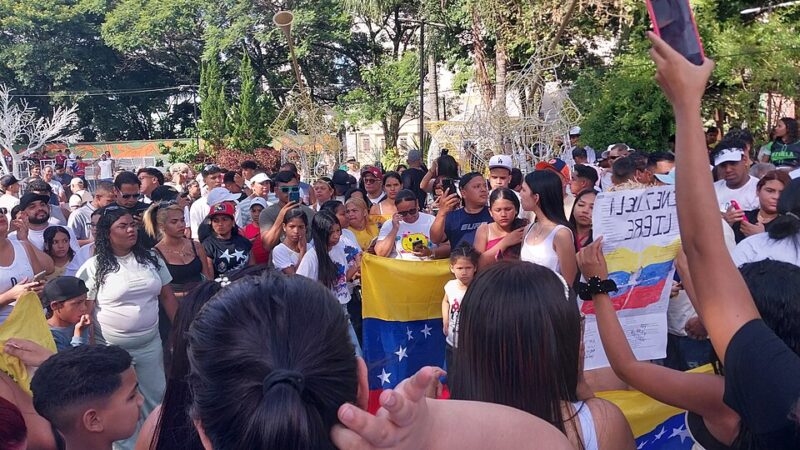

The first blast rattled Christian Pich Ortiz’s bedroom before sunrise, sending his mother and siblings into tears as detonations boomed over their community in Miranda, a state along Venezuela’s central coast.
To protect themselves, they dragged their mattresses off the beds and hid beneath them. Quickly, he told them to move downstairs because “we were going to stand up.” He was convinced this was not an accident. He had been expecting this blow after weeks of escalating threats from President Donald Trump and other U.S. officials.
“We understood immediately what was going on,” he said from a protest in Caracas, the day after the U.S. launched a military attack on Venezuela, leading to the arrest of the nation’s leader, Nicolás Maduro, and the killing of over 100 people in the nation’s capital city.
Ortiz is a proud Afro-Venezuelan, part of a once‑erased majority in the country of around 30 million people. Over half the population identifies as moreno (brown), Black, or Afro‑descendant — categories that researchers understand as largely reflecting African ancestry. This is the highest rate among the world’s Spanish-speaking countries.
The viral images of Venezuelan immigrants celebrating U.S. intervention highlight a sharp contrast to the experiences of some Afro-Venezuelans like Ortiz.
Capital B interviewed Afro-Venezuelans here in the U.S. and in the coastal country bordering the Caribbean Sea and Atlantic Ocean who said the reality is more complex. It is shaped by the country’s long history of denying racism and by who has actually borne the brunt of sanctions, poverty, and police violence.
“The people of the United States should know that they are not our enemies,” said Diógenes Díaz, an Afro-Venezuelan historian who lives in Caracas.
That complicated history has also produced a clear racial and class divide in how Venezuelans reacted to Maduro’s arrest. While many whiter, wealthier exiles publicly welcomed the U.S. strike, poorer, darker communities — especially along the coast — grappled with the immediate loss of life and uncertainty about what may follow.
Read more about this complicated situation.
Learn about activists during the Civil Rights Era.
Stay up to date with the latest Black news.
Comments Are Welcome
Note: We moderate submissions in order to create a space for meaningful dialogue, a space where museum visitors – adults and youth –– can exchange informed, thoughtful, and relevant comments that add value to our exhibits.
Racial slurs, personal attacks, obscenity, profanity, and SHOUTING do not meet the above standard. Such comments are posted in the exhibit Hateful Speech. Commercial promotions, impersonations, and incoherent comments likewise fail to meet our goals, so will not be posted. Submissions longer than 120 words will be shortened.
See our full Comments Policy here.