‘The Butler’: Lifting the Veil on Black Life
Share
Explore Our Galleries









Breaking News!
Today's news and culture by Black and other reporters in the Black and mainstream media.
Ways to Support ABHM?
By Henry Louis Gates Jr., TheRoot.com
I watched Lee Daniels’ The Butler in a standing-room-only theater on Martha’s Vineyard, with a thoroughly integrated audience of well-educated black and white people, whose ages ranged from teenagers and college students to midcareer professionals and retirees. The audience sat riveted over the entire course of the film, alternatively moved to laugh at the intraracial humor, to cry at the frailties and foibles of the all-too-human characters so vividly brought to life and to sit in pained — sometimes stunned — silence at the film’s most poignant revelations about the mysteries and horrors of race and race relations in 20th-century America.
[…]
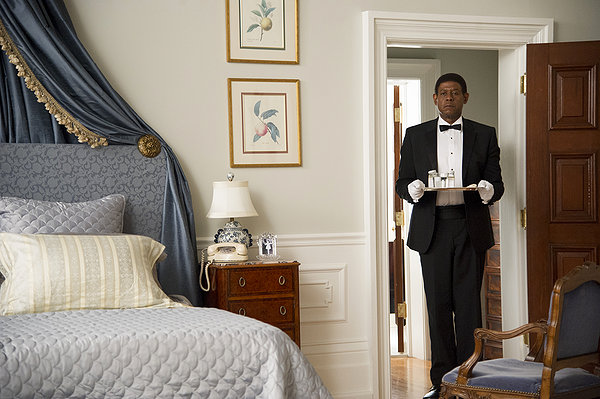
There are several reasons that I was so engrossed with the film’s plot and the brilliantly subtle ways that Daniels brought Danny Strong’s extraordinary screenplay to life, but upon reflection, I think the most important of these is Daniels’ and Strong’s uncanny capacity to lift the veil, as W.E.B. Du Bois so famously put it, on how black people actually talk to one another behind closed doors, when they are free to speak unconsciously, without censoring themselves in front of white people or in the presence of the black thought police.
[…]
But there is a second reason that I love this film: It achieves, implicitly, what so many black political figures and talking heads have been calling for since the George Zimmerman verdict was announced — that proverbial “conversation about race” called for, it seems, every time another racist incident is inflicted upon a black person.
Let me admit that I am dubious about “conversations about race” — not because we don’t need to continue to address how the historical or systematic manifestations of structural and institutional racism persist in affecting how each and every black person can conduct his or her daily life. We do. And not because I think that the other source of anti-black treatment of our people — individual attitudes, often unconscious ones, that reflect a deep-seated prejudice, rooted deep in the psyche — should not be analyzed and worked through in a collective, national therapy session. We so urgently need this kind of psychological cleansing of personal bias.
To check out the entire article, click here.
For more breaking news, click here.
Comments Are Welcome
Note: We moderate submissions in order to create a space for meaningful dialogue, a space where museum visitors – adults and youth –– can exchange informed, thoughtful, and relevant comments that add value to our exhibits.
Racial slurs, personal attacks, obscenity, profanity, and SHOUTING do not meet the above standard. Such comments are posted in the exhibit Hateful Speech. Commercial promotions, impersonations, and incoherent comments likewise fail to meet our goals, so will not be posted. Submissions longer than 120 words will be shortened.
See our full Comments Policy here.