The Brotherhood of Sleeping Car Porters & the Civil Rights Movement
Share
Explore Our Galleries

Breaking News!
Today's news and culture by Black and other reporters in the Black and mainstream media.
Ways to Support ABHM?

Members of the Brotherhood of Sleeping Car Porters. 1943, by Jack Delano.
By Scholar-Griot: Eleanor Olbinski, MA
For more than 100 years, the Pullman Company was known for luxury rail travel. This reputation was closely connected to the Pullman porters, Black service workers who faced racial discrimination, harassment, and unfair labor practices every day.
Despite these challenges, the porters worked to create the first all-Black labor union and helped lay the foundation for the Civil Rights Movement of the 1950s and 1960s.
Working for the Pullman Company meant long hours and low pay. Because all of George Pullman’s porters were Black, they were denied membership in the American Railway Union. That union accepted only White railway employees. As a result, porters took the risk of demanding better treatment from Pullman management themselves. In response, the Pullman Company created a company union and an “Employee Representation Plan” that offered many social benefits. However, the porters in this union had no real bargaining power to address their major concerns, including higher wages, shorter working hours, and compensation for supplies they purchased while working on the trains.
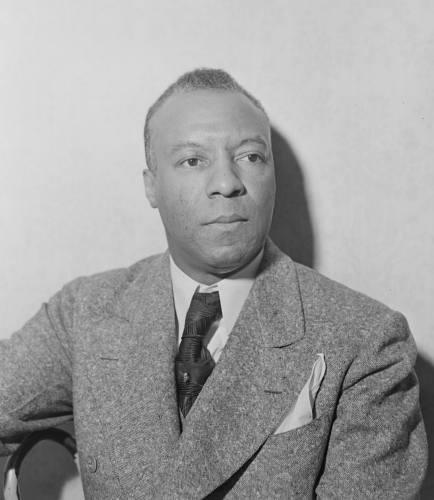
A. Philip Randolph. 1942. By Gordon Parks, The Library of Congress
During the 1910s, porters secretly circulated The Messenger, a labor rights magazine written by A. Philip Randolph. In the magazine, Randolph encouraged the formation of Black unions and supported racial integration. In 1925, Randolph was chosen to lead the Brotherhood of Sleeping Car Porters (BSCP), the first all-Black union in the United States. At age thirty-six, Randolph was not employed by the Pullman Company, so organizing the union would not cost him his job. Within the first year, half of all Pullman porters had joined the union.
The BSCP based its demands on those of another union, the Order of Sleeping Car Conductors. The union called for a 240-hour basic work month, pay for preparation time and delays, more opportunities for sleep while working on the cars, lower work-related expenses, and a living wage. The union faced a difficult beginning. It encountered opposition from the Pullman Company, the American Federation of Labor, and some Black leaders who believed the Pullman Company benefited the Black community. Porters who were found to have ties to the union were fired, causing membership numbers to decline.
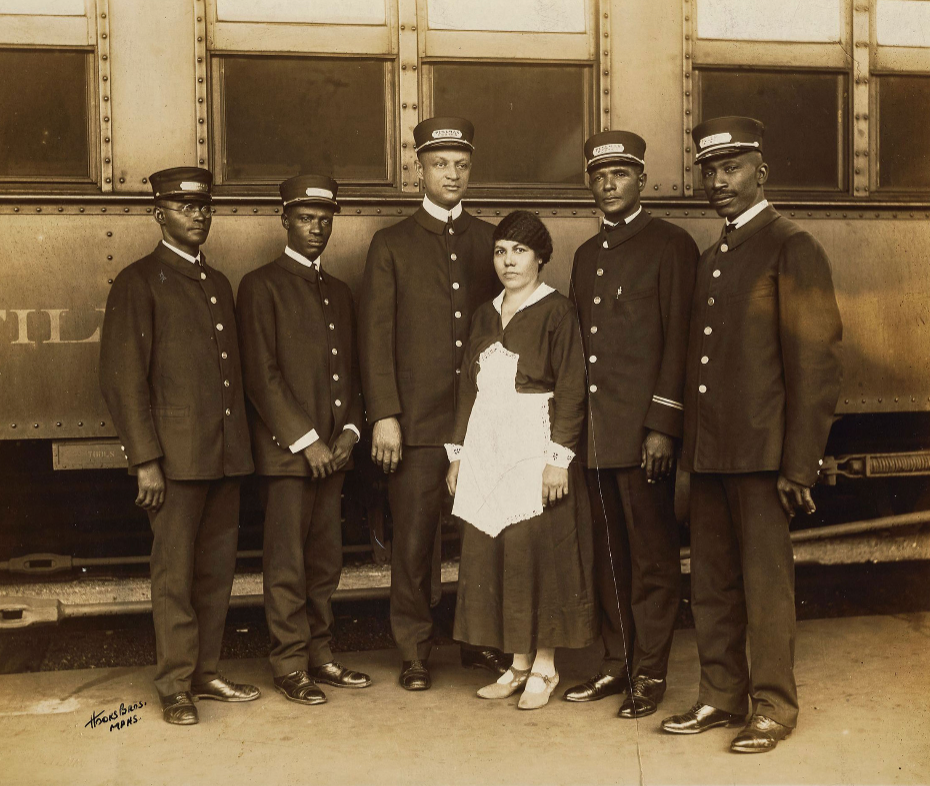
A Pullman maid surrounded by Pullman porters. A maid was often the only female crew member on the train. ©SMITHSONIAN AMERICAN ART MUSEUM, THE DR. ROBERT L. DRAPKIN COLLECTION
The Brotherhood of Sleeping Car Porters’ full name was the Brotherhood of Sleeping Car Porters and Maids, which allowed Pullman maids to become members. The Pullman maids, along with women connected to the Pullman Company, such as the wives of porters, provided the steady support necessary for the union to survive. They organized annual conventions, raised funds, managed local chapters, and hosted dinners for visiting Brotherhood leaders.
It took twelve years for the union to be recognized by the AFL, the national federation of labor unions in the United States. That same year, the first collective bargaining agreement was reached with the Pullman Company. The agreement limited working hours to 240 per month and increased wages.
The Civil Rights Movement
The Brotherhood of Sleeping Car Porters played an important role in the Civil Rights Movement from the 1950s through the 1960s. The union gave Black leaders the organizational skills needed to carry out large-scale civil rights campaigns. The union’s achievements also demonstrated the importance of Black labor to the larger United States economy.
In 1941, A. Philip Randolph planned a mass march on Washington to protest the exclusion of Black Americans from New Deal programs. These discriminatory programs included Social Security, which did not provide retirement benefits for agricultural workers or maids, and the Federal Housing Authority (FHA), which practiced “redlining.” The FHA refused to insure mortgages in or near Black neighborhoods. It also required deeds to include racial covenants that prevented non-White residents from purchasing homes in White neighborhoods.
The day before the planned March on Washington, President Franklin Delano Roosevelt (FDR) met with Randolph and established the Fair Employment Practice Committee to investigate racial discrimination in government jobs. In return, Randolph called off the march. However, in the mid-1950s, Randolph proposed another mass march on Washington.
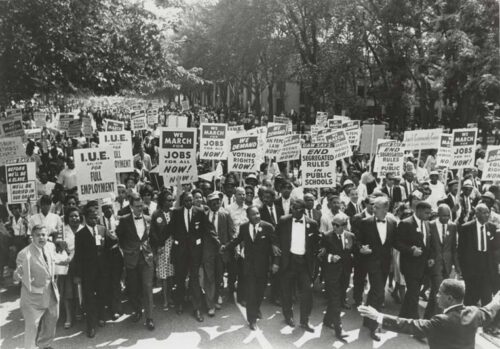
March on Washington for Jobs and Freedom, Martin Luther King, Jr. August 28, 1963. Public domain.
For this effort, he worked with Martin Luther King Jr. and the Southern Christian Leadership Conference to advocate for equal treatment and support the passage of the Civil Rights Act. This demonstration became the 1963 March on Washington for Jobs and Freedom, where Martin Luther King Jr. delivered his famous “I Have a Dream” speech.
Other well-known Civil Rights leaders also had connections to the Pullman porters. E. D. Nixon, a longtime civil rights leader in Alabama, began working as a Pullman porter in the 1920s. He joined the Brotherhood of Sleeping Car Porters, which inspired him to become an outspoken advocate for Black voting rights and economic opportunity. Nixon played a key role in launching the Montgomery bus boycott after Rosa Parks’ arrest. He helped secure Parks’s release from jail and asked Martin Luther King Jr. to lead the boycott meeting where King first gained national attention.
Malcolm X also worked for the Pullman Company for a short time. His experience as a porter influenced his views on race relations. He later recalled, “It didn’t take me a week to learn that all you had to do was give White people a show and they'd buy anything you offered them. We were in that world of [Black men] who are both servants and psychologists, aware that White people are so obsessed with their own importance that they will pay liberally, even dearly, for the impression of being catered to and entertained."1
US museums that feature Pullman cars in their collections that visitors may view or walk through:
- National Railroad Museum (Green Bay, WI): Features the "Lake Mitchell" 1920s Pullman sleeper car as part of its "Pullman Porters: From Service to Civil Rights" exhibit.
- Illinois Railway Museum (Union, IL): Known for having an extensive collection that includes cars such as the Pullman "Villa Real," "Villa Falls," and "Palm Lane".
- B&O Railroad Museum (Baltimore, MD): Displays the Pullman "Washington" Observation Tavern Car and a Pullman diner.
- Museum of the American Railroad (Frisco, TX): Houses a collection of Pullman cars, including the "Glen Nevis," a 6-3 sleeper.
- Tennessee Valley Railroad Museum (Chattanooga, TN): Features Pullman cars that highlight the history of luxury rail travel.
- Gold Coast Railroad Museum (Miami, FL): Features various passenger cars, including the SAL #259.
- Southeastern Railway Museum (Duluth, GA): Houses the Norfolk Southern 10-6 sleeper "Tugalo River," built by Pullman Standard.
- Monticello Railway Museum (Monticello, IL): Displays a 1918 Pullman-built railway post office car.
- National A. Philip Randolph Pullman Porter Museum (Chicago, IL): Focuses on the history of the Pullman porters and African-American labor history.
- Pullman National Historical Park (Chicago, IL): Located at the former Pullman factory site, offering tours of the grounds and administration building
Footnotes
1X, The Autobiography of Malcolm X, 86.
Eleanor Olbinski is a scholar and graduate of Queen’s University’s Master’s of History Program in Belfast, Northern Ireland. She has contributed research at the National Railroad Museum, the Sun Prairie Historical Museum, the Brown County Historical Society, the Hazelwood House, the Generations of Freedom Project, and the ABHM. Her research focuses on the symbiotic relationship between race and culture in the Reconstruction Era. Her work aims to highlight how racial injustice pervades daily interactions and bring to light moments of history previously ignored.