Bessie Coleman: Breaking Barriers in the Sky (1892 to 1926)
Share
Explore Our Galleries


Breaking News!
Today's news and culture by Black and other reporters in the Black and mainstream media.
Ways to Support ABHM?
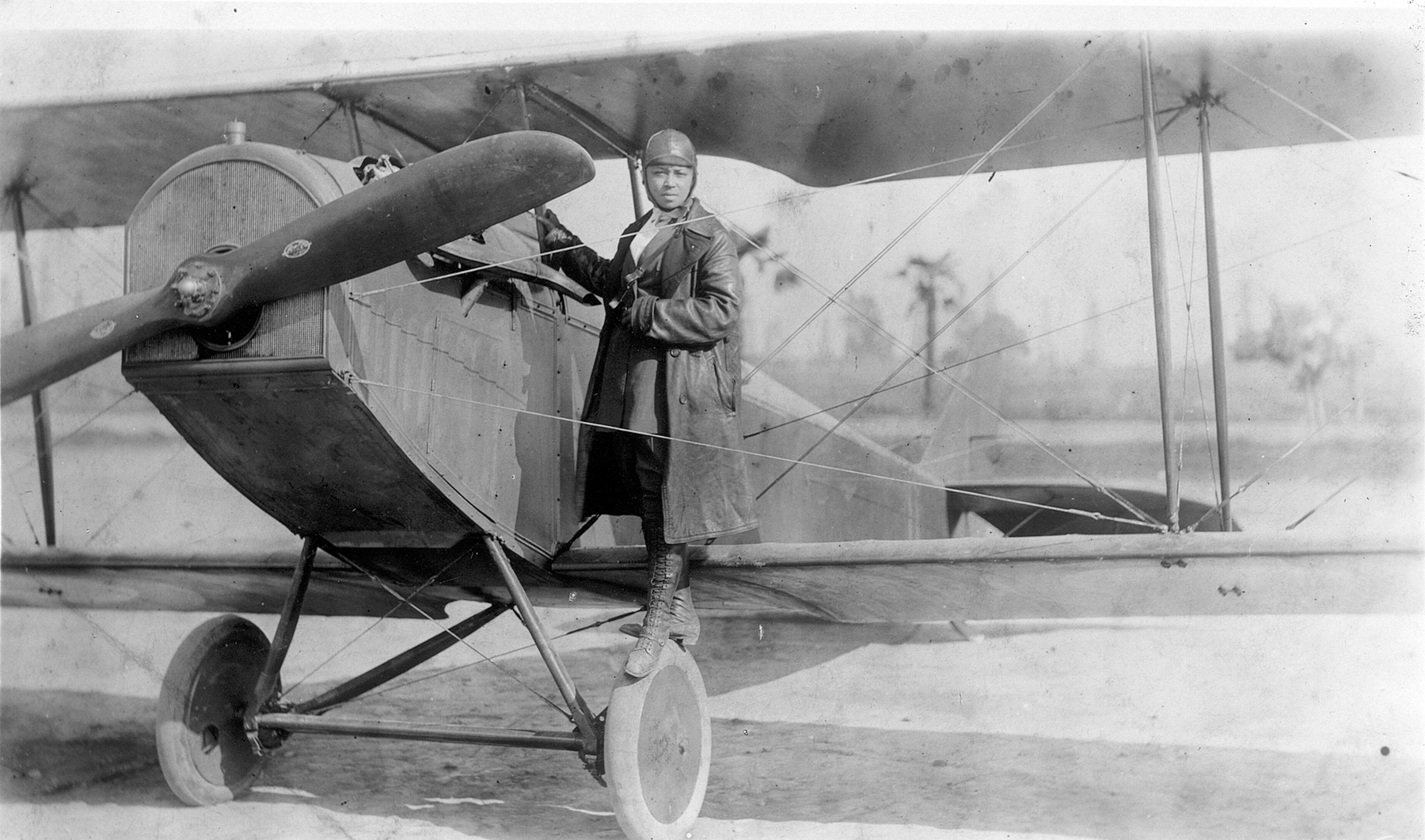
Bessie Coleman and her plane in 1922. UCLA Library Digital Collections, public domain.
By Scholar-Griot: Kristina Krozak
Early Life and Education
In the small town of Waxahachie, Texas, a young girl walked miles down a dusty road to a small, one-room schoolhouse. Even as a child, she dreamed of something bigger than the life she knew. Elizabeth “Bessie” Coleman was a middle child of thirteen in her family. She learned to lean on her brothers and sisters as they faced the tough life of Black families in the rural South.
Her mother, Susan Coleman, worked hard to support the family. She washed clothes for long hours and took any job she could get. Bessie saw her mother’s strength every day. Coming from a family of determined women, Bessie learned early that surviving took imagination and hard work.
Despite many challenges, Bessie wanted to learn. She loved reading and often taught herself from any book she could find, including the Bible. For Bessie, education felt like one of the few ways to make a better future.
After finishing high school, Bessie attended Langston University, an HBCU (Historically Black College) in Oklahoma. (Back then very few other US colleges let African American students in.) For a short time, it seemed a new world was opening for her. But after only one semester, she had to leave because she couldn’t pay for school and living expenses. Many poor students in the early 1900s faced this same problem. For them, college was financially out of reach.
Adult Life and Work
Bessie did not give up. She went back home to work and help her family. Still determined, she later joined one of her older brothers in Chicago, Illinois. Like many African Americans during the Great Migration, Bessie moved north in search of better opportunities.

1911. Chicago's Bronzeville. 43rd Street @ Grand Boulevard (King Drive), near where Bessie Coleman lived. Public domain.
In Chicago, she learned to be a beautician and worked as a manicurist in a busy barbershop. She earned a small living while watching the fast-paced city life around her. Chicago gave Bessie new ideas, new people, and a bigger world than she knew in Texas.
Her life changed in Chicago. Customers at the barbershop often talked about World War I and the brave pilots flying in Europe. Their stories amazed her. The more Bessie listened, the more she wondered if she, too, could fly.
At first, the idea seemed impossible. No Black woman in America had ever been a pilot. Every flight school said “No” to her because she was both Black and a woman. Even her brothers teased her, saying that women in France could fly, but American women would never get the chance.
But Bessie Coleman would not be discouraged. If the doors in America were closed, she would find another way.

Robert Abbott, 1920. Public domain
Making a Way Out of No Way
Leaders in Chicago’s Black community, including editor Robert Abbott of the Black newspaper Chicago Defender, encouraged her. In 1920, at the age of 28, Bessie left the United States and sailed to France to learn to fly.
Imagine leaving everything you know behind: your home, your family, even your language! Even before she even climbed into an airplane, Bessie’s journey took courage.
In France, she was able to join the Caudron Brothers School of Aviation – a respected flight school. For the first time, Bessie could chase the dream denied to her in the United States.
Tough Training

Cauldron training aircraft. Gary L Smith Collection. 1000AircraftPhotos.com.
Learning to fly in the early 1920s was very different from flying today. Planes were fragile, made of wood, wire, and cloth. Cockpits were open to the wind and cold. Pilots sat close to loud engines that filled the air with stinking fumes of oil and gas.
Training was hard and dangerous. Flying was still new, and accidents happened often. During her lessons, Bessie saw how quickly things could go wrong. Pilots sometimes crashed, and danger was always there.
Still, she persevered.
Each day, she climbed back into the cockpit and kept learning. She studied the planes, practiced difficult maneuvers, and worked hard to master flying. Sometimes she was afraid, but her determination was stronger than her fear.

Bessie Coleman pilot’s license. 1921, Public domain
Triumph At Last!
On June 15, 1921, Bessie Coleman did what once seemed impossible. She earned her international pilot’s license from the Fédération Aéronautique Internationale. She became the first African American woman and the first person of Native American descent to earn this license.
The girl who once walked for miles down Texas country roads had become a pilot.
When Bessie returned to the United States in 1921, news of her pilot’s license spread quickly. African American newspapers celebrated her success. Many communities wanted to meet the young aviator who had crossed the Atlantic to learn to fly.
Flying for a Living
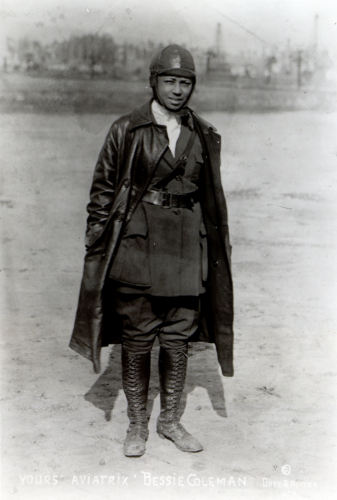
Bessie Coleman, circa 1922. Public domain
To earn a living as a pilot, Bessie turned to “barnstorming.”
Barnstorming was a popular kind of entertainment in the early days of flying. Pilots traveled from town to town, doing stunts and exciting crowds with their daring tricks in the air. These shows let people see airplanes up close for the first time and feel the thrill of flight.
For Bessie, barnstorming brought opportunity and visibility.
Crowds watched in amazement as her plane climbed high into the sky, then dove toward the ground before pulling up at the last moment. She performed loops, figure eights, and other daring tricks. Newspapers soon called her “Queen Bess.”
Her performances made her one of the most famous Black aviators of her time.
But the attention she got was complicated. Some promoters saw her as a novelty rather than a professional pilot. They focused on the spectacle instead of on her skills. But Bessie knew how to use the spotlight.
Flying For Equality
She refused to perform at events where Black spectators had to enter through different gates than Whites or sit in segregated areas. If Black audiences would not be treated equal to White audiences, she would cancel the show.
In this way, Bessie Coleman made her flights much more than simple entertainment. Each flight was a statement that the sky should belong to everyone.

Bessie Coleman, circa 1925. Public domain
Her dreams reached beyond applause. Bessie hoped to open a flight school where African American students could learn to fly without facing the barriers she had faced. She believed future generations deserved the opportunities she had fought for.
Triumph To Tragedy To Inspiration
Tragically, Bessie Coleman’s life ended on April 30, 1926, in a freak accident during a rehearsal flight in Jacksonville, Florida. She was only thirty-four years old. Ms. Coleman was deeply mourned and was buried in Chicago.
Her courage and determination inspired generations of aviators, including the Tuskegee Airmen and many others who continued the fight for equality in American aviation.
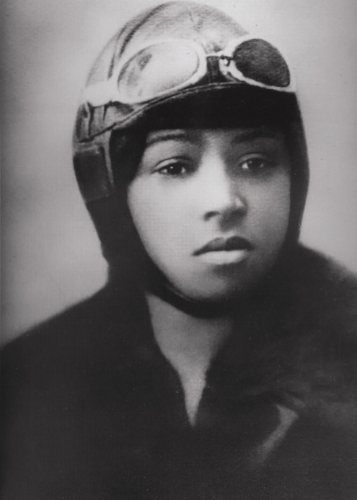
Bessie Coleman, 1921. Public domain.

Bessie Coleman, 1923. Public domain
References
Bach, Richard. A Gift of Wings. New York: Dell Publishing, 1975.
Bridges, Kenneth D. Bridges Aviation Studies. Seattle: Bridges Aviation Studies Publishing, 1973.
Fischer, Audrey. “Bessie Coleman: Flying in the Face of All Odds.” Woman Pilot, March–April 1995.
Grimes, Nikki. Talkin’ About Bessie: The Story of Aviator Elizabeth Coleman. Illustrated by E. B. Lewis. New York: Orchard Books, 2002.
Hardesty, Von, and Dominick Pisano. Black Wings: The African American in Aviation. Washington, DC: National Air and Space Museum, Smithsonian Institution, 1983.
Hine, Darlene Clark, ed. Black Women in America. New York: Carlson Publishing, 1993.
Igus, Toyomi, ed. Book of Black Heroes: Great Women in the Struggle. Vol. 2. East Orange, NJ: Just Us Books, 1991.
Rich, Doris L. Queen Bess, Daredevil Aviator. Washington, DC: Smithsonian Institution Press, 1993.
Rich, Doris L. “My Quest for Queen Bess.” Air & Space Magazine, August–September 1994.
Saint-Exupéry, Antoine de. Wind, Sand and Stars. New York: HBJ Modern Classic Series, 1992.
Smith, Jessie Carney, ed. Notable Black American Women. Detroit: Gale Research, 1992.
Waters, Enoch P. American Diary: A Personal History of the Black Press. Chicago: Path Press, 1987.
About the Curator
Kristina Krozak is a writer and researcher dedicated to preserving overlooked histories and bringing them to life for modern audiences. Her work explores civil rights history, pioneering historical figures, and the individuals who challenged barriers and expanded opportunities for future generations.