The Black Artists Claiming More Space Than Ever Before
Share
Explore Our Galleries









Breaking News!
Today's news and culture by Black and other reporters in the Black and mainstream media.
Ways to Support ABHM?
by Emily Lordi, New York Times
New monumental works are filling landscapes and galleries, where they argue for the freedom and power to play.
IN 2020, THE artist Kiyan Williams began deep-frying American flags, first encasing small, souvenir-size Stars and Stripes in bubbled golden skin, then cooking a full-size nylon banner with paprika and flour. It was a gesture of play as much as protest, striking above all for Williams’s decision not to burn the flags but to preserve their crisp, and oddly appetizing, ruination. Last year, around the same time that those works were displayed at Lyles & King gallery in New York, Williams, 32, scaled up their practice by installing a 13-by-8-foot structure of hardened earth called “Ruins of Empire” in Brooklyn Bridge Park. The sculpture referenced the bronze Statue of Freedom (designed by the sculptor Thomas Crawford and fabricated by enslaved laborers) perched atop the dome of the U.S. Capitol since 1863, while sinking it into the earth. Rather than destroying a cherished American symbol, Williams was once again staging its decomposition — now in a larger sense and in view of the public. “I hate to use the word ‘magic,’” Williams says. “It’s like a mystery. People ask, ‘How is this standing? How is this here?’”
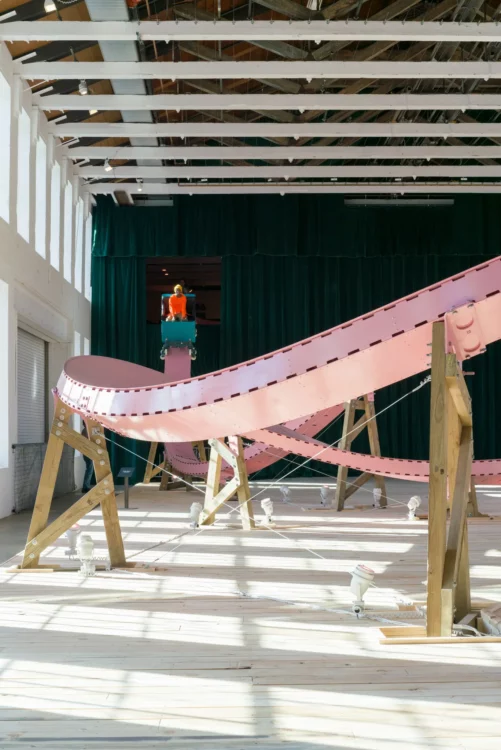
While the history of America can inspire fantasies of scorched-earth demolition, Williams is one of several Black artists to respond instead with massive experimental construction. “Ruins” is part of a trend toward monumental Black art located in outdoor public spaces, as well as in the museum. Last April, Simone Leigh, 55, the first Black woman to have her work shown at the U.S. Pavilion at the Venice Biennale, filled the venue with towering abstract sculptures of Black female forms — including the 16-foot-high bronze bust “Brick House” (2019), originally installed on the High Line overlooking 10th Avenue in Manhattan. (Leigh’s first museum survey opens April 6 at the Institute of Contemporary Art/Boston.) Charles Gaines’s “The American Manifest: Moving Chains,” a 110-foot-long bargelike structure made of steel and African mahogany, with nine 1,600-pound chains churning overhead, arrived at New York’s Governors Island last October. (It’s widely thought to evoke the slave trade.) Hank Willis Thomas, 47, has created several huge works, such as the 19-ton bronze homage to Martin Luther King Jr. and Coretta Scott King recently unveiled on the Boston Common. Xaviera Simmons’s recent exhibition at the Queens Museum in New York, “Crisis Makes a Book Club,” featured a 16-foot-high structure, “Align,” representing the imagined response of white women to the antiracist books they’ve been reading. And at the Massachusetts Museum of Contemporary Art in North Adams, Mass., EJ Hill, 37, has built an operational roller coaster, its rails painted cotton candy pink.
These works are monumental in every sense — in terms of the money, time, labor and space required to make them, as well as their social and technical ambition. Their creators, all of whom have worked in other media like painting and photography, describe them as manifestations of creative dreams; and the effect of encountering them can, as Williams notes of “Ruins,” verge on sublime. Their appeal is elemental in a nation where we marvel at the sheer size of things; and political, given that those with the resources to create such works, whether within museums or parks, have historically not been Black.
[..]
BLACK ARTISTS HAVE long staked large-scale claims to the visual landscape of the United States — whether by painting the community-based Wall of Respect mural created by the Organization of Black American Culture (OBAC) in Chicago in 1967, tagging the New York City subways with graffiti or creating outdoor sculptures such as Tyree Guyton’s Heidelberg Project, a series (begun in 1986) of brightly painted abandoned houses on Detroit’s east side. But the canvases for these works were typically pre-existing structures, and making them was relatively inexpensive (and, in the case of graffiti, often illegal), whereas today’s free-standing sculptures require social sanction and robust institutional support. According to the art historian Gwendolyn DuBois Shaw, new, “high-profile, well-funded commissions” are at last going to Black artists.
Comments Are Welcome
Note: We moderate submissions in order to create a space for meaningful dialogue, a space where museum visitors – adults and youth –– can exchange informed, thoughtful, and relevant comments that add value to our exhibits.
Racial slurs, personal attacks, obscenity, profanity, and SHOUTING do not meet the above standard. Such comments are posted in the exhibit Hateful Speech. Commercial promotions, impersonations, and incoherent comments likewise fail to meet our goals, so will not be posted. Submissions longer than 120 words will be shortened.
See our full Comments Policy here.