Nearly 4m records of enslaved people in 20 former British colonies now searchable online
Share
Explore Our Galleries









Breaking News!
Today's news and culture by Black and other reporters in the Black and mainstream media.
Ways to Support ABHM?
Aamna Modhin, The Guardian
Exclusive: Collection’s 300,000 pages record lives of enslaved people in countries including the Bahamas, Barbados, Jamaica, Mauritius, South Africa and Trinidad
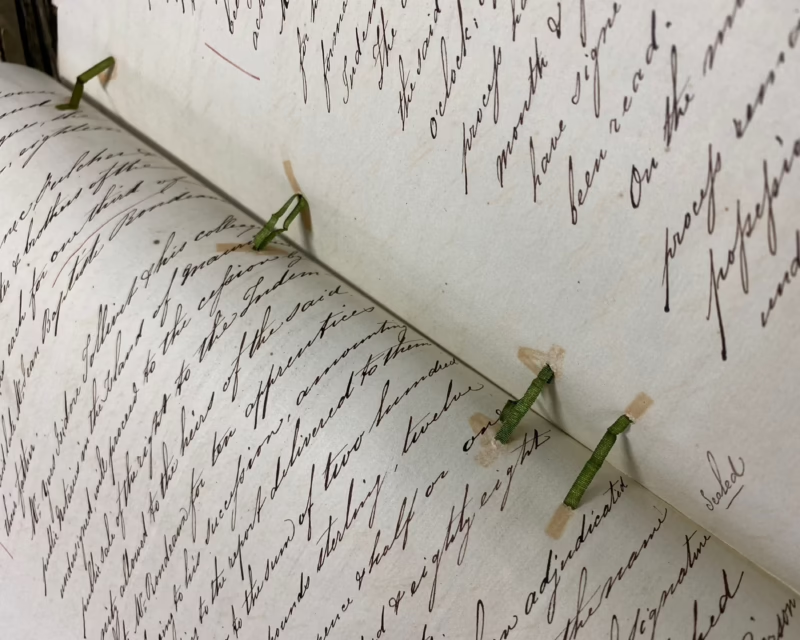
Nearly 4m records documenting the lives of enslaved people across 20 former British colonies have been made searchable online for the first time.
The records have been digitised and indexed by the genealogy company Ancestry, which has partnered with the Centre for the Study of the Legacies of British Slavery at University College London.
The global collection offers millions of descendants across the African-Caribbean and wider African diasporas access to one of the most extensive surviving archives of British enslavement, potentially helping them uncover family histories.
The collection, known as the Former British Colonies Enslavement Registers, contains about 300,000 pages recording enslaved people across former British colonial dependencies between 1813 and 1840, including the Bahamas, Barbados, the Cape of Good Hope in South Africa, Jamaica, Mauritius and Trinidad.
When you see the names of individuals and their ages and their children … it transforms how you understand the system
The registers were created by the British government after the abolition of the transatlantic slave trade in 1807, and were designed to prevent illegal trading of enslaved people and to monitor the enslaved population.
Researchers say people were recorded in the registers with chilling precision. Entries include names, ages, physical descriptions and family ties, as well as births, deaths and transfers of ownership. Some distinguish whether a person was born in Africa or in the Caribbean.
Nicka Sewell-Smith, a professional genealogist and senior story producer at Ancestry, said it was not lost on her that records originally created to count enslaved people as property were now being used by their descendants to reconstruct their family histories.
Learn more about this project.
Read about slavery in the UK’s largest former colony, the USA.
This year’s breaking news has included multiple stories about the monarchy’s involvement with slavery.
Comments Are Welcome
Note: We moderate submissions in order to create a space for meaningful dialogue, a space where museum visitors – adults and youth –– can exchange informed, thoughtful, and relevant comments that add value to our exhibits.
Racial slurs, personal attacks, obscenity, profanity, and SHOUTING do not meet the above standard. Such comments are posted in the exhibit Hateful Speech. Commercial promotions, impersonations, and incoherent comments likewise fail to meet our goals, so will not be posted. Submissions longer than 120 words will be shortened.
See our full Comments Policy here.