Madeleine L’Engle’s Private Correspondence With Ahmad Rahman
Share
Explore Our Galleries









Breaking News!
Today's news and culture by Black and other reporters in the Black and mainstream media.
Ways to Support ABHM?
When the prolific author of A Wrinkle in Time began exchanging letters with a Black Panther imprisoned for a murder he didn’t commit, neither could have imagined what the relationship would yield.
By, Vanity Fair
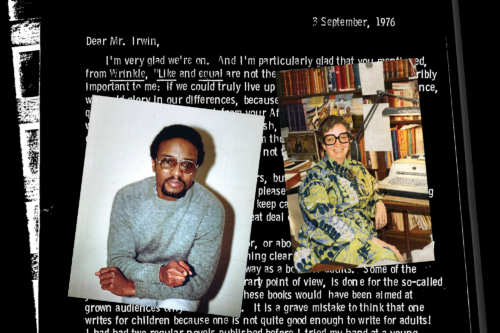
Man of Letters Ahmad Rahman, photographed in 1983, by which time his correspondence with Madeleine L’Engle had bloomed into a fruitful mutual mentorship.FROM BUSWELL LIBRARY SPECIAL COLLECTIONS, WHEATON, ILLINOIS (L’ENGLE); FROM MADELEINE L’ENGLE PAPERS, SOPHIA SMITH COLLECTION, SSC-MS-00801, SMITH COLLEGE S P ECIAL COLLECTIONS, NORTHAMPTON, MASSACHUSETTS (LETTER); COURTESY OF DR. AHMAD A. RAHMAN’S FAMILY (RAHMAN).
Madeleine L’Engle’s mail arrived in prodigious batches by the summer of 1976, 14 years after the publication of A Wrinkle in Time. From her study in Manhattan’s Cathedral Church of Saint John the Divine, where she served as librarian, the 57-year-old author attended to editorial correspondence, fan art, manila envelopes stuffed with middle-school-reader responses, royalty statements, and speaking requests from around the world. Amid the usual haul, one correspondent stood out: Ron Irwin, inmate #130539 at the State Prison of Southern Michigan, a 25-year-old former member of the Black Panther Party.
Irwin, who later converted to Islam and adopted the name Ahmad Rahman, had just received an honorable mention in the nonfiction category of the 1976 PEN America Writing Award for Prisoners. PEN had recently launched a correspondence program pairing writers in prison with established writers on the outside…
A young PEN administrator named John Morrone played matchmaker. L’Engle, he knew, had asked to be a mentor. He forwarded Rahman’s concerns and writing samples. L’Engle saw raw talent. “I believe that literature is, in fact, a strong common meeting ground,” she responded to Morrone, “but he may not agree. I certainly have no objection to his writing out of his own background. That’s all any of us has to work from.” She typed an introductory letter to Rahman and had a copy of Wrinkle sent to the prison because, she told Morrone, “science fiction/fantasy transcends barriers of race.”
It was a match made of opportunity—as for alchemy, time would tell what no one then could have predicted: that a “mystical connection,” in Rahman’s words, would bind them for life; that their surviving letters—more than 200 pages—would lay bare the senselessness of excessively punitive “justice” and the ravages of mass incarceration; that the integrity of two extraordinary people would breed a leveling intimacy, making way for a mutual mentorship that purposefully, sometimes painfully, worked through the obstacles of politics, class, race, religion, gender, and generation…
Read the full article here.
Learn more about Dr. Rahman here and the Black Panther Party here
More Breaking News here
Comments Are Welcome
Note: We moderate submissions in order to create a space for meaningful dialogue, a space where museum visitors – adults and youth –– can exchange informed, thoughtful, and relevant comments that add value to our exhibits.
Racial slurs, personal attacks, obscenity, profanity, and SHOUTING do not meet the above standard. Such comments are posted in the exhibit Hateful Speech. Commercial promotions, impersonations, and incoherent comments likewise fail to meet our goals, so will not be posted. Submissions longer than 120 words will be shortened.
See our full Comments Policy here.