FBI agents sue after being fired for kneeling during racial justice protest
Share
Explore Our Galleries









Breaking News!
Today's news and culture by Black and other reporters in the Black and mainstream media.
Ways to Support ABHM?
Carrie Johnson, NPR
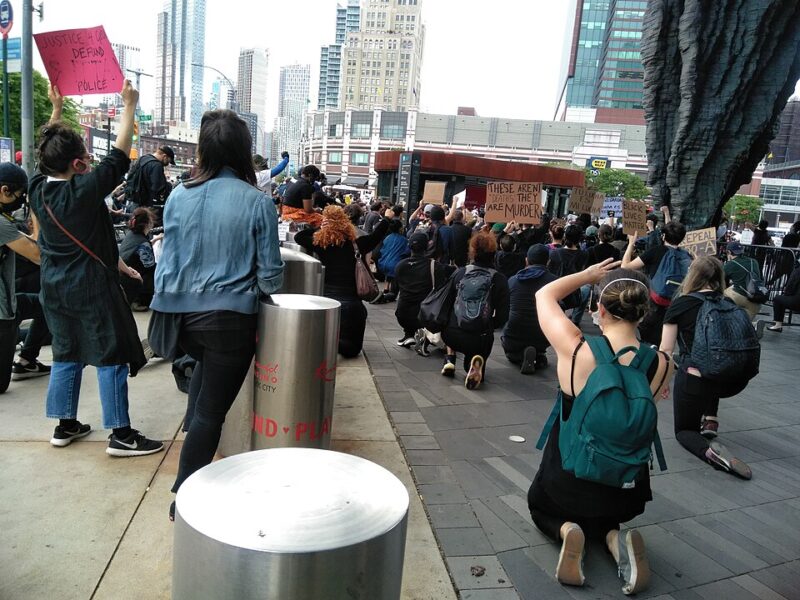
Adjoajo, CC BY-SA 4.0, via Wikimedia Commons)
Twelve FBI agents who were fired this year for taking a knee during racial justice protests in the heated summer of 2020 are suing the Bureau and its director, alleging unlawful retaliation.
The former special agents—who together have nearly 200 years of experience—once received awards for helping disrupt mass shootings, expose foreign spies and thwart cyber attacks.
But they say as elite federal law enforcement agents, they never received training on crowd control, nor did they have riot shields, gas masks, or helmets when they faced down volatile crowds in the streets of Washington, D.C., in June 2020.
The lawsuit, filed in federal court in Washington on Monday, described the small group of FBI agents as vastly outnumbered and literally backed against the wall of the National Archives building as unrest swept the country over the murder of George Floyd by a Minneapolis police officer. Court papers said they kneeled not to reflect a left-wing political point of view, but rather to de-escalate a situation that threatened to spin out of control.
“Mindful of the potentially catastrophic consequences, Plaintiffs knew that a split-second misjudgment by any of them could ignite an already-charged national climate and trigger further violence and unrest,” said the lawsuit, filed by former Justice Department prosecutor Mary Dohrmann of the Washington Litigation Group.
Keep reading to learn more about this case.
Comments Are Welcome
Note: We moderate submissions in order to create a space for meaningful dialogue, a space where museum visitors – adults and youth –– can exchange informed, thoughtful, and relevant comments that add value to our exhibits.
Racial slurs, personal attacks, obscenity, profanity, and SHOUTING do not meet the above standard. Such comments are posted in the exhibit Hateful Speech. Commercial promotions, impersonations, and incoherent comments likewise fail to meet our goals, so will not be posted. Submissions longer than 120 words will be shortened.
See our full Comments Policy here.