‘Change has come’: Mississippi unveils Emmett Till statue
Share
Explore Our Galleries









Breaking News!
Today's news and culture by Black and other reporters in the Black and mainstream media.
Ways to Support ABHM?
By Emily Wagster Pettus, Associated Press
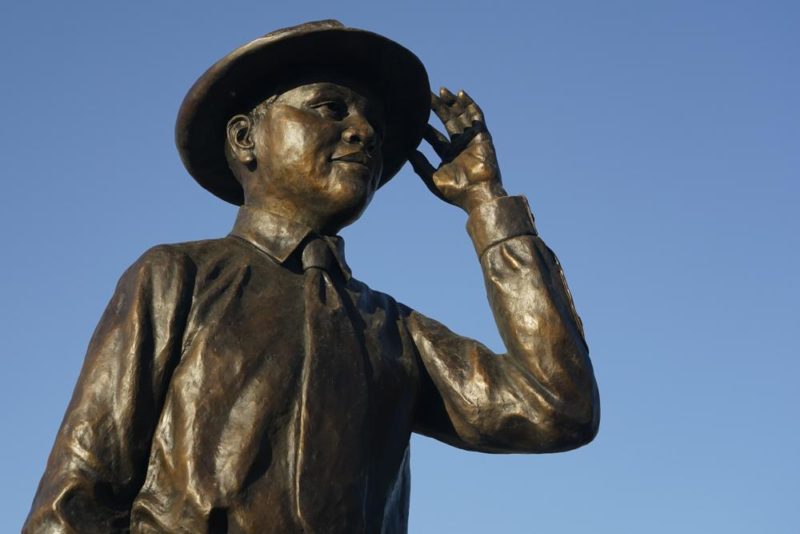
GREENWOOD, Miss. (AP) — Hundreds of people applauded — and some wiped away tears — as a Mississippi community unveiled a larger-than-life statue of Emmett Till on Friday, not far from where white men kidnapped and killed the Black teenager over accusations he had flirted with a white woman in a country store.
“Change has come, and it will continue to happen,” Madison Harper, a senior at Leflore County High School, told a racially diverse audience at the statue’s dedication. “Decades ago, our parents and grandparents could not envision that a moment like today would transpire.”
The 1955 lynching became a catalyst for the civil rights movement. Till’s mother, Mamie Till-Mobley, insisted on an open-casket funeral in Chicago so the world could see the horrors inflicted on her 14-year-old son. Jet magazine published photos of his mutilated body, which was pulled from the Tallahatchie River in Mississippi.
[…]
Anna-Maria Webster of Rochester, New York, had tears running down her face.
“It’s beautiful to be here,” said Webster, attending the ceremony on a sunny afternoon during a visit with Mississippi relatives. Speaking of Till’s mother she said: “Just to imagine the torment she went through — all over a lie.”
Pettus discusses race in Mississippi.
Till was one victim of lynching; find others in our memorial to lynching victims.
Comments Are Welcome
Note: We moderate submissions in order to create a space for meaningful dialogue, a space where museum visitors – adults and youth –– can exchange informed, thoughtful, and relevant comments that add value to our exhibits.
Racial slurs, personal attacks, obscenity, profanity, and SHOUTING do not meet the above standard. Such comments are posted in the exhibit Hateful Speech. Commercial promotions, impersonations, and incoherent comments likewise fail to meet our goals, so will not be posted. Submissions longer than 120 words will be shortened.
See our full Comments Policy here.