Buffalo celebrates Black service members with historic monument dedication
Share
Explore Our Galleries









Breaking News!
Today's news and culture by Black and other reporters in the Black and mainstream media.
Ways to Support ABHM?
By Claretta Bellamy, NBC News
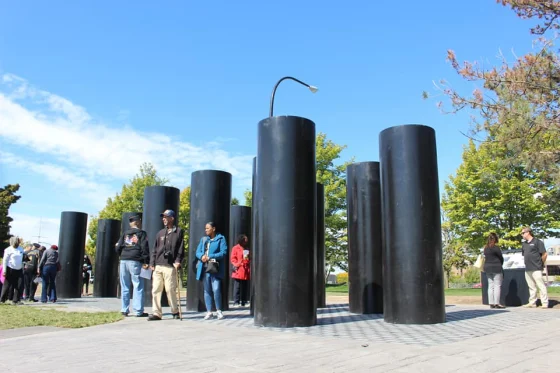
For the first time in history, Black veterans are getting a monument to acknowledge their service and contributions in the U.S. military.
The African American Veterans Monument was unveiled Saturday in Buffalo, New York, to honor Black veterans and active-duty military service members both past and present. The monument serves as a permanent marker recognizing the contributions of African Americans who served in the Army, the Navy, the Air Force, the Marines and the Coast Guard.
Military members, veterans and city and state officials, including New York State Assembly Majority Leader Crystal Peoples-Stokes, gathered in the Buffalo and Erie County Naval & Military Park, the largest naval park in the country, for the unveiling ceremony. The event came two days after the anniversary of the preliminary Emancipation Proclamation, the document issued by President Abraham Lincoln on Sept. 22, 1862, that set a date for the end of slavery.
Designed by the late artist Jonathan Casey, the concrete monument is made up of 12 black pillars stretching 10 feet tall and 3 feet wide. The pillars are in chronological order marking the 12 wars Black soldiers served in: from the American Revolution in 1775 to the current war on terrorism. The spacing between pillars is also significant, as it represents the times of peace between one war and the next.
Bellamy discusses the significance of this memorial.
Black veterans have contributed greatly to the Civil War, yet some point out the inequalities they experience compared to white veterans.
Check out our breaking news section.
Comments Are Welcome
Note: We moderate submissions in order to create a space for meaningful dialogue, a space where museum visitors – adults and youth –– can exchange informed, thoughtful, and relevant comments that add value to our exhibits.
Racial slurs, personal attacks, obscenity, profanity, and SHOUTING do not meet the above standard. Such comments are posted in the exhibit Hateful Speech. Commercial promotions, impersonations, and incoherent comments likewise fail to meet our goals, so will not be posted. Submissions longer than 120 words will be shortened.
See our full Comments Policy here.