Lawsuit claims slavery persists at former St. James plantation with unmarked graves
Share
Explore Our Galleries









Breaking News!
Today's news and culture by Black and other reporters in the Black and mainstream media.
Ways to Support ABHM?
By Wesley Muller, Lousiana Illuminator
Environmental groups claim Formosa Plastics is violating the 13th Amendment by controlling access to the site
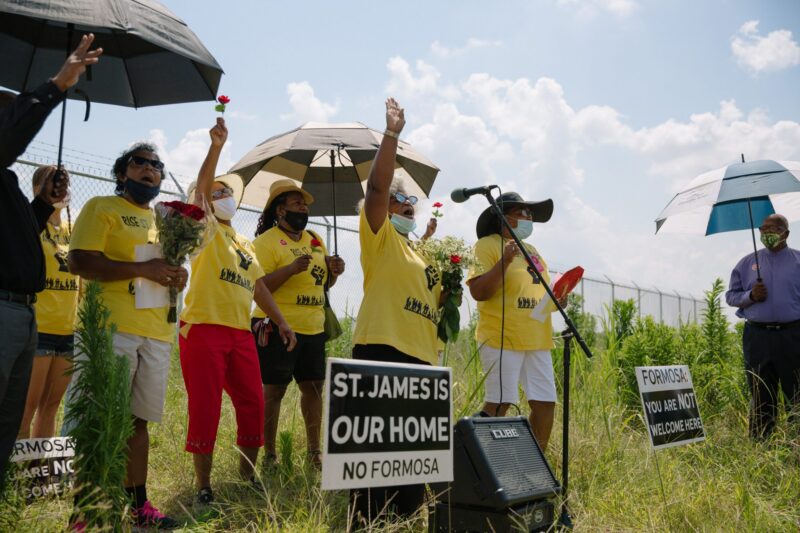
Community activists with ancestral ties to enslaved people at Louisiana plantations are using a unique legal theory to gain access to an unmarked slave cemetery on the property of a petrochemical company. They claim the company is practicing slavery by owning and controlling the bodies of people buried there.
Inclusive Louisiana and the Descendants Project, two St. James Parish environmental justice organizations, joined forces to file a lawsuit against FG LA, an American affiliate of the Taiwanese petrochemical giant Formosa Plastics. One of their primary claims in the lawsuit is based on the U.S. Constitution’s 13th Amendment, which prohibits slavery and involuntary servitude.
At the center of the lawsuit is a cemetery discovered on a tract of land Formosa purchased in 2017 to construct a massive $9.4 billion plastics facility. The land, located along the Mississippi River in St. James Parish, was once the site of Buena Vista Plantation, where enslaved Africans are believed to have been buried.
Filed in the federal court for the Eastern District of Louisiana, the plaintiffs want to end Formosa’s control over the cemetery and the individuals buried there. They also claim Formosa has violated the 13th Amendment and Louisiana’s cemetery law by restricting access to the gravesites.
In 2018, during the permitting process for Formosa’s project, archaeologists discovered unmarked graves on the property. They believe the site is a burial ground for some of the slaves forced to work at Buena Vista before and during the Civil War. When local residents from majority-Black St. James Parish learned of the graves, they began to visit the site to pray and honor their enslaved ancestors, the lawsuit states.
[…]
The new lawsuit makes similar accusations, drawing parallels between plantation owners in the 1860s and the actions of Formosa as a corporate landowner in the 2020s.
“This is an action to enforce rights to access, maintain, care for, and protect a cemetery under cemetery dedication law in Louisiana and to eradicate one of the ‘lingering vestiges of the slave system’ pursuant to the Thirteenth Amendment of the United States Constitution – the continued ownership and control of the bodies of those enslaved under the slavery system,” the lawsuit states.
Learn what legal experts think about this approach.
This argument prompts us to consider the role of ownership in slavery.
Comments Are Welcome
Note: We moderate submissions in order to create a space for meaningful dialogue, a space where museum visitors – adults and youth –– can exchange informed, thoughtful, and relevant comments that add value to our exhibits.
Racial slurs, personal attacks, obscenity, profanity, and SHOUTING do not meet the above standard. Such comments are posted in the exhibit Hateful Speech. Commercial promotions, impersonations, and incoherent comments likewise fail to meet our goals, so will not be posted. Submissions longer than 120 words will be shortened.
See our full Comments Policy here.