Black Holocaust Museum convenes diverse group for film/dialogue series
Share
Explore Our Galleries









Breaking News!
Today's news and culture by Black and other reporters in the Black and mainstream media.
Ways to Support ABHM?
By Stephanie Harte, Milwaukee Neighborhood News Service
 During the past three months, Reggie Jackson and Fran Kaplan of America’s Black Holocaust Museum brought together people of different races, ages and genders to talk about the role institutional racism plays in people’s lives.
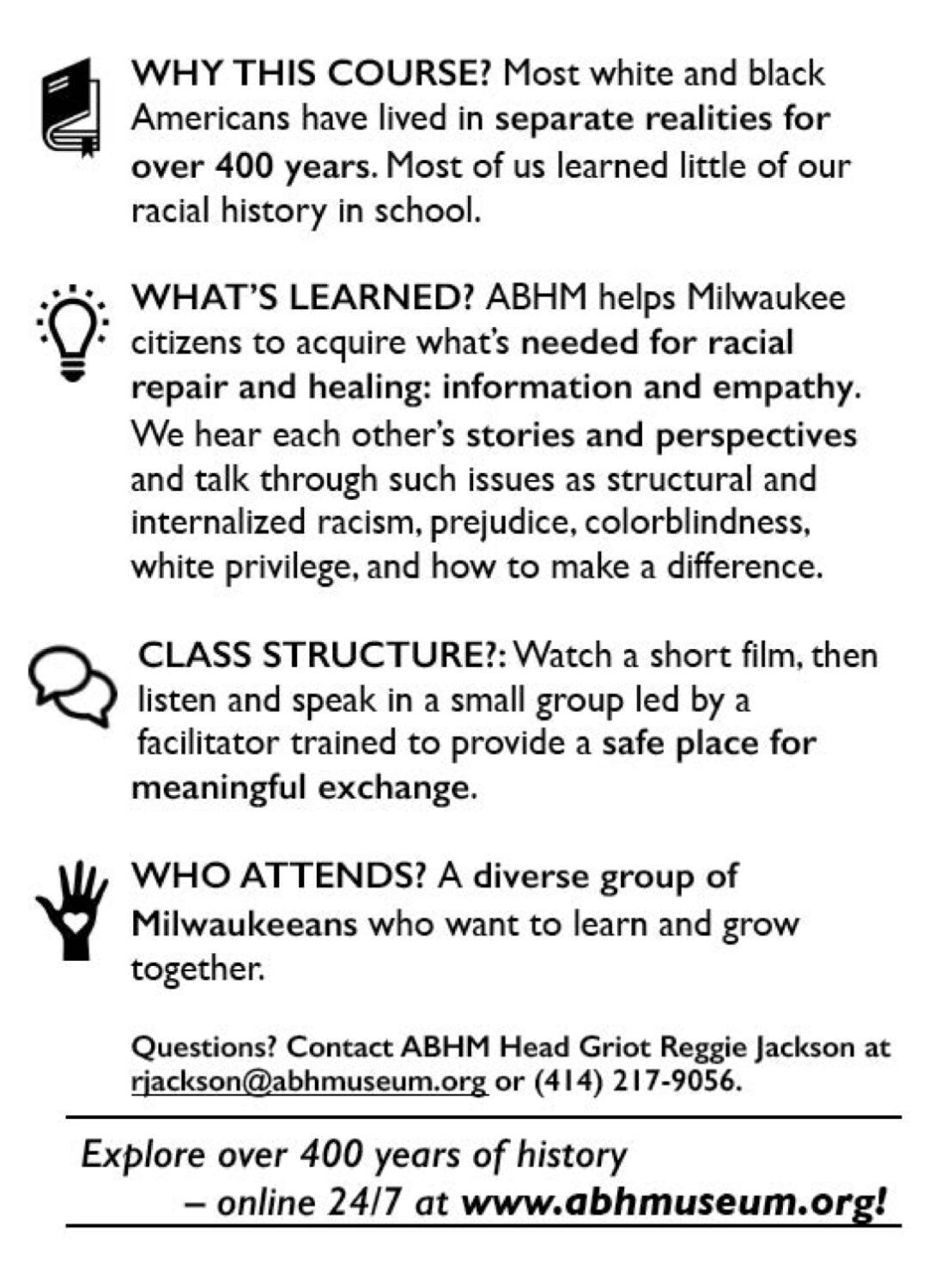
The museum recently concluded “White Frame/ Black Frame: The Hidden Roots of Racial Realities,” a free six-session film and interracial dialogue series. Participants were asked to commit to all six sessions so members could build trust with one another.
Fifty people, ranging from teens to senior citizens, participated in the series. They were divided into seven discussion groups and each was assigned a facilitator.
Jackson, head griot, and Kaplan, the virtual museum’s coordinator, showed a short film clip at each session from “White People,” a 2015 documentary about white privilege in the United States, to trigger discussion….
Participants also suggested film clips for Kaplan and Jackson to show during the series. Donte McFaddan, co-founder and co-programmer of the Black Lens Program at the Milwaukee Film Festival, participated in the series and suggested several clips including portions of “Hollywood Shuffle.” The film follows an actor limited to stereotypical roles because he is black.

“Seeing that there are differences in how we experience life allows us to come together,” Jackson said. “We hope people learn that institutional racism plays a role in all of our lives.”

Troy Freund, who participated in White Frame/Black Frame, works as an independent photographer in Milwaukee and around the Midwest.
Troy Freund, a participant in the series, said the clips drove home the reality of how serious racism is. He added that he benefited from hearing his group members’ reactions.
“We all have to learn about ourselves,” Freund said. “I love my city, I’ve lived here for 20-something years, so I signed up (for the series) thinking ‘let’s see what I can learn.’”…
Maria Cunningham, a librarian at the Milwaukee Public Library and ABHM volunteer, served as a facilitator and put together a suggested reading list for the participants. One of the selections was How Does It Feel to Be a Problem? by Moustafa Bayoumia, which details how young Arab and Muslim Americans are often viewed as the enemy in American society. White Like Me: Reflections on Race from a Privileged Son, by Tim Wise, an author and educator, also was included on the list.
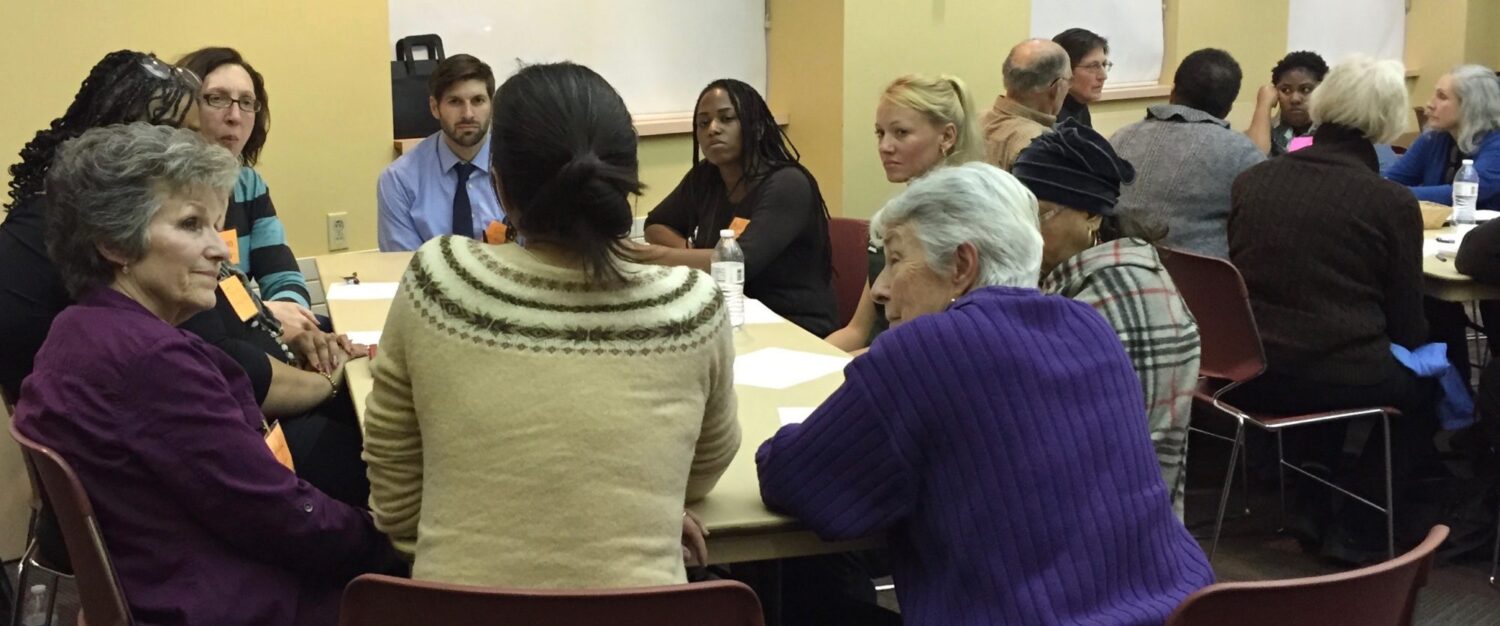
Maria Cunningham (center) listens intently to a group member during “Hidden History,” ABHM’s 2015 film/dialogue series.
Cunningham said she enjoyed watching participants become more comfortable as the weeks went on. “Programs like this show that people can talk about these problems and that it is safe to do so,” Cunningham said.
“It is very gratifying to see people of so many different groups come together and have very civil conversations,” Jackson said.
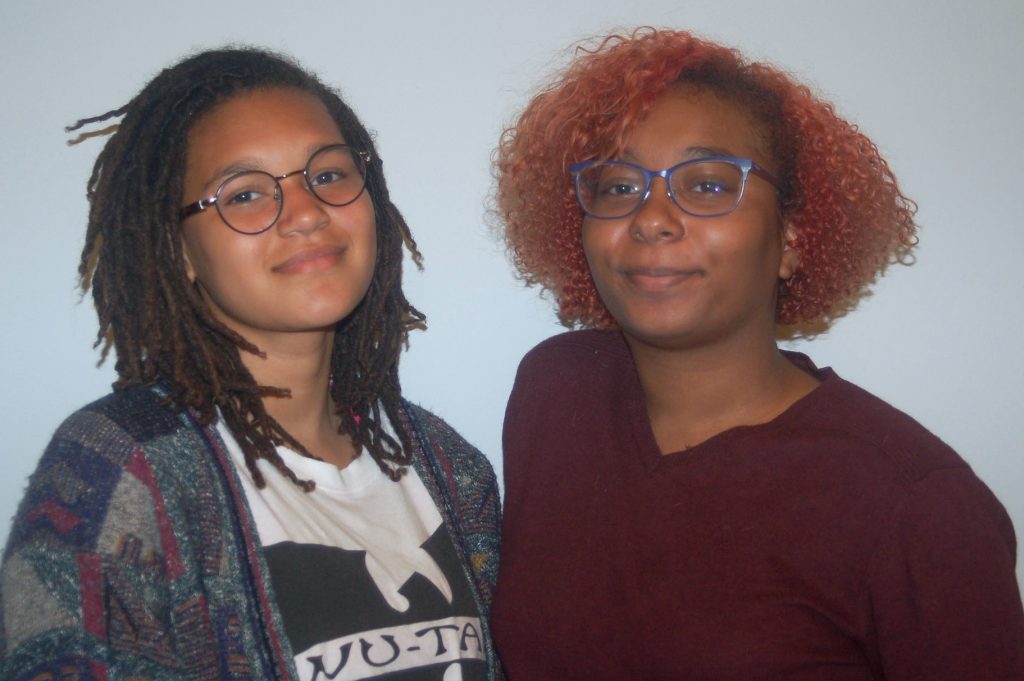
Ni’Sea Thurman, 15, and Stephania Parrett, 17, were part of a group of trained community members who facilitated the program’s small group dialogues.
Nisea Thurman-Wamubu, 15, and Stephania Parrett, 17, were the two youngest facilitators. Both participate in Urban Underground, an organization of young people committed to building safe and sustainable communities….
The teens both agreed it was difficult at times to explain topics to people older than they are. “I felt so privileged to gain their trust,” Thurman-Wamubu said. “I never felt so much joy to share with others.”
“White Frame/ Black Frame” was the third yearly film and dialogue series hosted by ABHM. In prior years, full-length films and documentaries were shown, allowing less time for dialogue.
 “We could see we needed more time to dialogue to take out a deeper meaning,” Kaplan said. “Having a place where we could talk so honestly is what made it work so well.”
Jackson and Kaplan hope to start hosting the film dialogue series more than once a year, since they had a waiting list for “White Frame/ Black Frame.”
Read the full article here.
More Breaking News here.
Comments Are Welcome
Note: We moderate submissions in order to create a space for meaningful dialogue, a space where museum visitors – adults and youth –– can exchange informed, thoughtful, and relevant comments that add value to our exhibits.
Racial slurs, personal attacks, obscenity, profanity, and SHOUTING do not meet the above standard. Such comments are posted in the exhibit Hateful Speech. Commercial promotions, impersonations, and incoherent comments likewise fail to meet our goals, so will not be posted. Submissions longer than 120 words will be shortened.
See our full Comments Policy here.