A Civil War Among Neighbors Over Confederate-Themed Streets
Share
Explore Our Galleries


Breaking News!
Today's news and culture by Black and other reporters in the Black and mainstream media.
Ways to Support ABHM?
By Antonio Olivo, The Washington Post
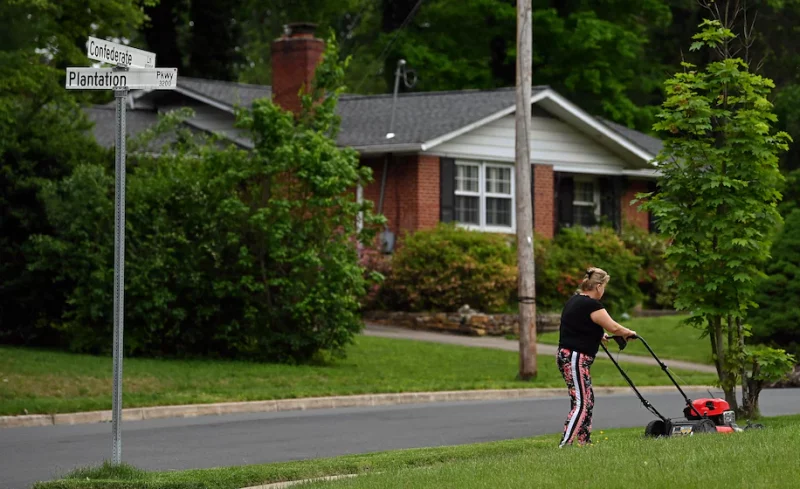
On the corner of Confederate Lane and Plantation Parkway in the Civil War-themed housing development of Mosby Woods, a “Black Lives Matter” lawn sign faces the two street markers.
A few blocks away in the same Northern Virginia development, other signs urge neighbors to “Save Ranger Rd!!” while cars bear parking permits with the neighborhood’s logo: a Confederate Raider on horseback charging into battle with saber raised…
For decades, street names that reflected Virginia’s Confederate past were a sometimes awkward fact of life for the neighborhood’s residents, in line with the surrounding landscape of Civil War battleground sites and historical markers, monuments and highways honoring Confederate generals like Robert E. Lee and Stonewall Jackson.
That changed with the murder of George Floyd by a former Minneapolis police officer in 2020, which unleashed a reckoning over systemic racism in the country that, in turn, ignited a backlash against perceived anti-White sentiments that has filled social media feeds and fueled a culture war over race and ethnicity.
Now, the increasingly diverse neighborhood, named after Confederate army battalion commander John S. Mosby, that is otherwise a typical suburban enclave — with summer block parties and holiday decoration contests — is another battleground, with the City Council set to decide in June whether nine streets in Mosby Woods should be called something else.
Keep reading to learn more about the movement to change street names.
Confederate names and symbols have a long and contentious history, reflecting society’s inequality, despite costly maintenance. But recent efforts have replaced confederate statues with Black changemakers.
Follow our breaking news page to catch change as it happens.
Comments Are Welcome
Note: We moderate submissions in order to create a space for meaningful dialogue, a space where museum visitors – adults and youth –– can exchange informed, thoughtful, and relevant comments that add value to our exhibits.
Racial slurs, personal attacks, obscenity, profanity, and SHOUTING do not meet the above standard. Such comments are posted in the exhibit Hateful Speech. Commercial promotions, impersonations, and incoherent comments likewise fail to meet our goals, so will not be posted. Submissions longer than 120 words will be shortened.
See our full Comments Policy here.