Local history: Great-grandson shares family stories about Akron man who grew up in slavery
Share
Explore Our Galleries









Breaking News!
Today's news and culture by Black and other reporters in the Black and mainstream media.
Ways to Support ABHM?
By Mark J. Price, Akron Beacon Journal
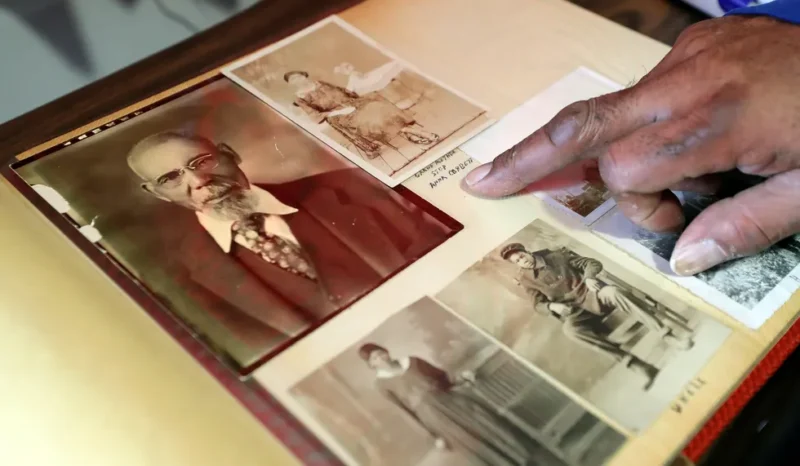
Ramont Wright’s ancestors watch over him.
They gaze down from black-and-white photographs arranged in rows along the walls of his living room on Andrus Street in South Akron. His home serves as a shrine to those who came before.
“Every day that I wake up, I see my mother, my father, my uncles, my aunts, my grandmothers, my grandfathers on both sides of my family,” he said.
Wright, 68, keeps their memories alive by sharing their stories.
One portrait reveals a slender, older gentleman wearing a three-piece suit, eyeglasses and neatly cropped beard. It’s Wright’s great-grandfather, who used to live down the street on Andrus.
“That’s him right there,” Wright pointed out. “That’s Henry Corbett.”
The two share more than DNA.
When Wright was growing up, neighborhood kids — especially his cousins — teased him about his middle name.
“My mom named me Ramont Henry Wright,” he said. “I asked my mom, ‘You know, I like Ramont, but where the hell did y’all get this country-ass name Henry from?’ Because I never liked it.”
Mary Wright explained to her son: “When I was pregnant, your great-grandfather asked me to give you his name.”
Corbett grew up as an enslaved person in the South in the 19th century.
For only four months, their lives overlapped: Wright was born in March 1956 and Corbett died in July 1956. It’s possible that his great-grandfather held him on Andrus Street as an infant.
[…]
Henry L. Corbett was something of an Akron celebrity in the 1950s. The Beacon Journal conducted interviews with him at his home, where he used to sit in a rocking chair on his front porch and smoke a pipe.
He explained that he was born near Wilmington, North Carolina, and grew up on “the Corbett plantation,” which may be a reference to the 10,000-acre Black River Plantation near Ivanhoe. Its owner was William Murphy Corbett, who operated a turpentine distillery and other businesses.
“Slaves always took the names of their masters in those days,” Corbett told reporter Helen Waterhouse in 1954.
[…]
Learn how Corbett was treated as a house servant and the impact slavery has had on his family.
Even though some of the enslaved were treated better, enslavement still oppressed.
Comments Are Welcome
Note: We moderate submissions in order to create a space for meaningful dialogue, a space where museum visitors – adults and youth –– can exchange informed, thoughtful, and relevant comments that add value to our exhibits.
Racial slurs, personal attacks, obscenity, profanity, and SHOUTING do not meet the above standard. Such comments are posted in the exhibit Hateful Speech. Commercial promotions, impersonations, and incoherent comments likewise fail to meet our goals, so will not be posted. Submissions longer than 120 words will be shortened.
See our full Comments Policy here.