An appeals court has struck down a key path for enforcing the Voting Rights Act
Share
Explore Our Galleries









Breaking News!
Today's news and culture by Black and other reporters in the Black and mainstream media.
Ways to Support ABHM?
By Hansi Lo Wang, NPR
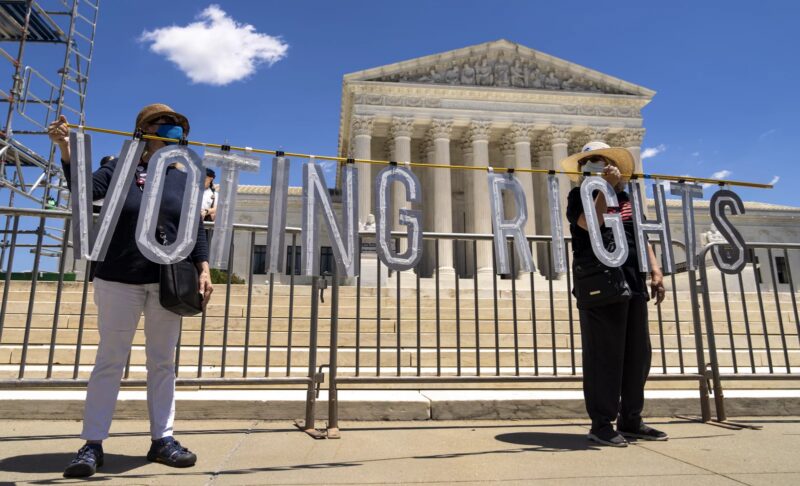
Demonstrators hold up large cut-out letters spelling “VOTING RIGHTS” at a 2021 rally outside the U.S. Supreme Court in Washington, D.C. (Drew Angerer/Getty Images)
A federal appeals court has struck down a key path for enforcing the Voting Rights Act.
The new ruling in an Arkansas redistricting lawsuit may set up the next U.S. Supreme Court fight that could further limit the reach of the Voting Rights Act’s protections for people of color.
The legal dispute is focused on who is allowed to sue to try to enforce key provisions under Section 2 of the landmark civil rights law, which was first passed in 1965.
Private individuals and groups, who did not represent the U.S. government, have for decades brought the majority of Section 2 cases to court. Those cases have challenged the redrawing of voting maps and other steps in the elections process with claims that the voting power of people of color has been minimized.
U.S. District Judge Lee Rudofsky, an appointee of former President Donald Trump, ruled in February 2022, however, that only the head of the Justice Department, the U.S. attorney general, can bring Section 2 lawsuits and dismissed an Arkansas redistricting case brought by advocacy groups representing Black voters in the state.
On Monday, that lower court ruling was upheld in a 2-1 vote by a three-judge panel of the 8th U.S. Circuit Court of Appeals, whose rulings apply to Arkansas, Iowa, Minnesota, Missouri, Nebraska, North Dakota and South Dakota.
Read more in the original article.
Learn about an unsung hero that fought for voting rights in this virtual exhibit.
Find even more Breaking News here.
Comments Are Welcome
Note: We moderate submissions in order to create a space for meaningful dialogue, a space where museum visitors – adults and youth –– can exchange informed, thoughtful, and relevant comments that add value to our exhibits.
Racial slurs, personal attacks, obscenity, profanity, and SHOUTING do not meet the above standard. Such comments are posted in the exhibit Hateful Speech. Commercial promotions, impersonations, and incoherent comments likewise fail to meet our goals, so will not be posted. Submissions longer than 120 words will be shortened.
See our full Comments Policy here.