Wisconsin still has Confederate monuments and symbols despite its history as a progressive state. Here’s what they are.
Share
Explore Our Galleries









Breaking News!
Today's news and culture by Black and other reporters in the Black and mainstream media.
Ways to Support ABHM?
ByThe Milwaukee Journal Sentinel
Despite Wisconsin’s allegiance to the Union during the Civil War, its loyalties to the Union and the end of slavery were not as clear-cut as Wisconsinites might like to think — and symbols of the Southern Confederacy still survive here…
Slavery was still practiced into the 1840s, even though it was made illegal by the 1787 Northwest Ordinance, said Patrick Jung, professor of history and anthropology at the Milwaukee School of Engineering. Southern soldiers, lead miners and farmers brought slaves to Wisconsin with them in the 1820s, and an 1840 census confirmed 11 slaves living in the state, though historians say there were many more unaccounted for.
The first recorded draft riots — in opposition to President Abraham Lincoln’s call for soldiers to join the Union — occurred in Port Washington.
In 2017, Madison removed two memorials for the Confederate soldiers who died at Camp Randall. But several Confederate symbols remain in Wisconsin, and slavery is still referred to in the state constitution…
Here’s what we know about how the Confederacy lingers in the Badger State.
Racine Horlick High School Rebels
Horlick High School in Racine was established in 1928 and has held the team name “Rebels” since 1949…
In 2002, Horlick vowed to replace its Confederate-inspired mascot and erase related symbols from the school, according to the Racine Journal Times. But the school retained “Rebby the Rebel” until two years ago, according to Racine United School District spokesperson Stacy Tapp.
On June 8, a petition created by Horlick alumnus Shannon Campion asked for the school to “cut all ties to the Confederacy.” More than 2,000 people had signed it as of June 25…
Confederate Spy Belle Boyd’s Wisconsin grave
Maria Isabella “Belle” Boyd was a spy for Thomas J. “Stonewall” Jackson and other Confederate generals.
On June 11, 1900, Belle Boyd was on a speaking tour when she died of a heart attack in Kilbourn City (now Wisconsin Dells). She is buried in Spring Grove Cemetery, where she remains, marked by a plaque — and a Confederate flag.
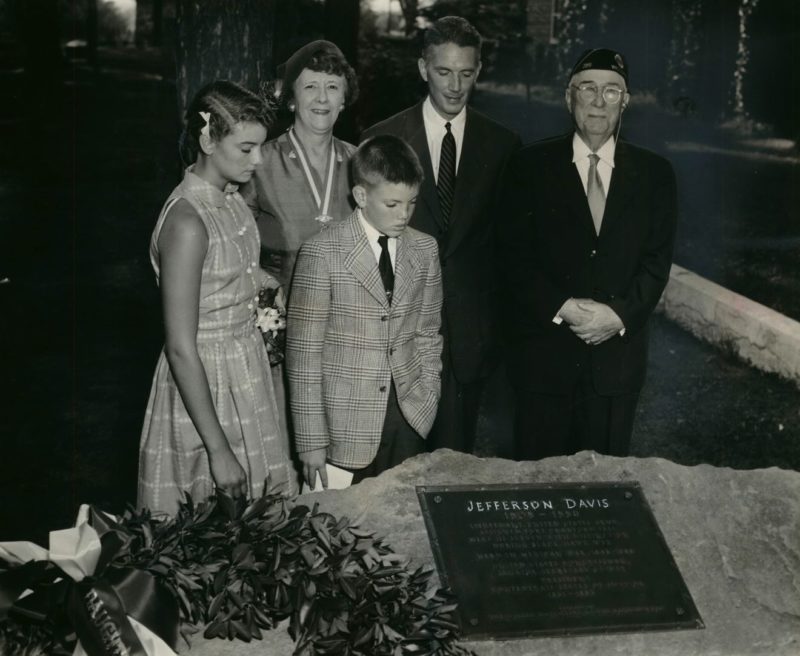
Jefferson Davis monument at Fort Crawford Military Cemetery
Davis, president of the short-lived Confederacy, has a monument at Fort Crawford Military Cemetery in Prairie du Chien. He spent time in the state between 1828 and 1832.
The cemetery is federal property under the U.S. Department of Veterans Affairs…
Read the full article here.
Visit more galleries and exhibits here.
More Breaking News here.
Comments Are Welcome
Note: We moderate submissions in order to create a space for meaningful dialogue, a space where museum visitors – adults and youth –– can exchange informed, thoughtful, and relevant comments that add value to our exhibits.
Racial slurs, personal attacks, obscenity, profanity, and SHOUTING do not meet the above standard. Such comments are posted in the exhibit Hateful Speech. Commercial promotions, impersonations, and incoherent comments likewise fail to meet our goals, so will not be posted. Submissions longer than 120 words will be shortened.
See our full Comments Policy here.