Researchers at Art Gallery of Ontario identify painter and subject of 18th-century portrait of Black woman
Share
Explore Our Galleries









Breaking News!
Today's news and culture by Black and other reporters in the Black and mainstream media.
Ways to Support ABHM?
Larry Humber, The Art Newspaper
Curators at the gallery are now piecing together the transatlantic journeys of Eleonora Susette, an enslaved woman who travelled from present-day Guyana to Amsterdam and back
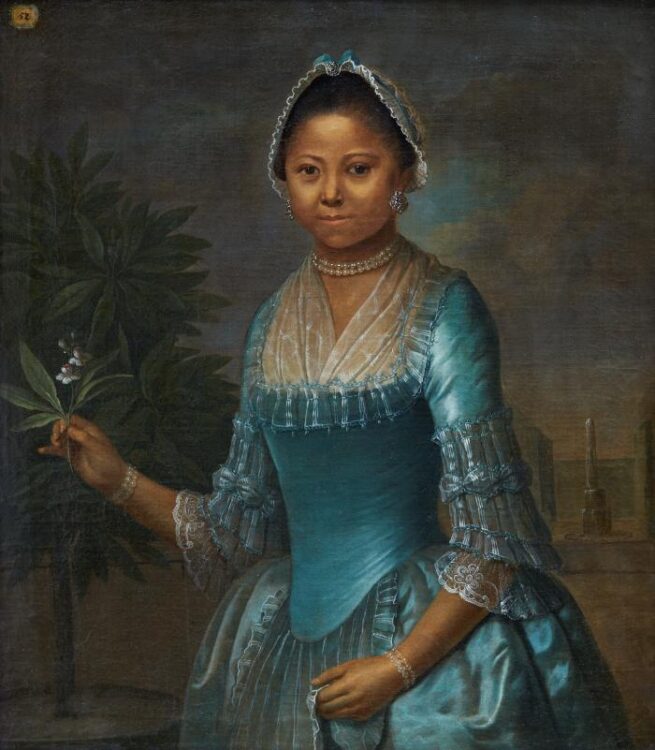
Both the painter and the sitter of a portrait of a young woman of colour purchased at auction by the Art Gallery of Ontario (AGO) in 2020 have finally been identified after lots of digging, a little luck and a reframing. The first name of the painting’s subject is Eleonora Susette (her last name remains unknown); she was born around 1756 in Berbice, a Dutch colony known for sugar and molasses in what is now Guyana. The artist is the Berlin-born artist Jeremias Schultz (1722-1800).
While still a teen, Eleonora Susette was enslaved and made to work alongside her mother for the colony’s governors. In the portrait she is elegantly dressed, sports fine jewellery and has a confident bearing. She holds an orange blossom, hence the painting’s former title, “Portrait of a Lady Holding an Orange Blossom”. Now that she has been identified, the piece has been retitled Portrait of Eleonora Susette (1775).
Trying to identify her and the painter posed a challenge for Adam Harris Levine, the AGO’s associate curator of European art, and Monique Johnson, the gallery’s former interim associate curator of European art. There was not much to go on, though there was a partial signature on the work—“J.Schul…fec”. Another work attributed to Schultz, this one of a young man of colour who is also elegantly outfitted, known as Portrait of a young man wearing a green jacket holding a cane, proved helpful in identifying Eleonora Susette. (That work is held in a private collection.)
After around a year of research, Johnson was able to identify the artist as Schultz, who was mainly active in the Netherlands and typically painted portraits of merchants of the then-thriving Dutch colonial empire. But from there research stalled, as relatively little is known about Schultz’s life and work, and the Dutch colonies were numerous and widely dispersed—numbering nearly 30 at the height of the empire.
“We were looking for two young people of colour who were living in Amsterdam in the 1770s and would have occasion to be painted by Jeremias Schultz,” Levine recently told the AGO’s in-house magazine, Foyer. “That, frankly, felt like a complete dead end to me.”
Even so, he and Johnson kept looking. “We tried many different theories,” he tells The Art Newspaper. “Then this incredible email came.” It was from a mother and her son in the Netherlands, with ties to the artist.
Learn how that email led to a revelation.
Check out our Special Exhibits for more art.
Comments Are Welcome
Note: We moderate submissions in order to create a space for meaningful dialogue, a space where museum visitors – adults and youth –– can exchange informed, thoughtful, and relevant comments that add value to our exhibits.
Racial slurs, personal attacks, obscenity, profanity, and SHOUTING do not meet the above standard. Such comments are posted in the exhibit Hateful Speech. Commercial promotions, impersonations, and incoherent comments likewise fail to meet our goals, so will not be posted. Submissions longer than 120 words will be shortened.
See our full Comments Policy here.