Why It Isn’t Possible For Black Americans To Appropriate African Culture
Share
Explore Our Galleries









Breaking News!
Today's news and culture by Black and other reporters in the Black and mainstream media.
Ways to Support ABHM?
By Julia Craven, Politics Reporter, The Huffington Post
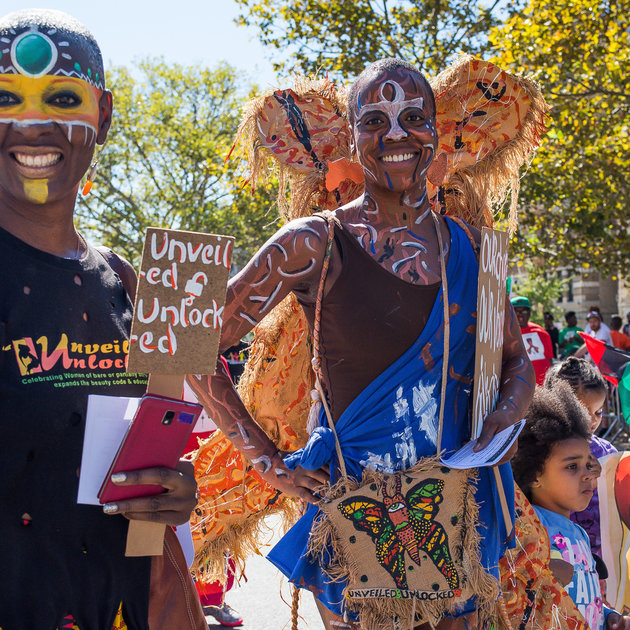
Parade participants march with a tribal-themed group wearing colorful face paint. (Photo by Albin Lohr-Jones/Pacific Press/LightRocket via Getty Images)
Columbus Fortune was the name given to my great-great grandmother’s grandfather. I only know this because my Nana is a stickler for attempting to compose family trees. I say “attempting” because, with the exception of what has been told to us, it is difficult to recount an undocumented lineage.
My grandfather was an enslaved African. He was 18 when slavery was abolished in the United States and I don’t know if he knew his mother, his father, his brothers, his sisters or his grandparents. I do not know if he knew what tribe he hailed from.
For black Americans, tracing our lineages back to their African origins is almost impossible (unless we use DNA testing). African enslavement left us devoid of a way to define ourselves. It severed familial ties and deprived us of any viable opportunity to reclaim them. When we go looking for our ancestors and their culture, we’re chasing shadows.
This is why it hurts when native Africans criticize black American attempts to regain a lost portion of ourselves. Writer Zipporah Gene, who identifies as both British and Nigerian, wrote a post earlier this month claiming that black Americans can appropriate African culture — since we are American — by wearing tribal garb to be “trendy.” Backlash to her piece led her to write an equally obtuse follow-up declaring that, based on her own experiences, it is unnecessary for black people to showcase their Africanness…
It is understandable why an African woman might look at a picture of Afropunk’s New York festival attendees, recoil and believe her culture is being used as a costume (though The Root pointed out that, because of New York’s diversity, whether or not the people in the photo are African-American or African immigrants cannot be determined). But cultural appropriation requires a degree of economic and political privilege black Americans simply do not have. We cannot oppress Africans, shame their cultures, claim it for ourselves and then decide it’s trendy. Even if we could, that’s certainly not what’s happening here, by any stretch of the imagination…
Read the full article here.
Read more Breaking News here.
Comments Are Welcome
Note: We moderate submissions in order to create a space for meaningful dialogue, a space where museum visitors – adults and youth –– can exchange informed, thoughtful, and relevant comments that add value to our exhibits.
Racial slurs, personal attacks, obscenity, profanity, and SHOUTING do not meet the above standard. Such comments are posted in the exhibit Hateful Speech. Commercial promotions, impersonations, and incoherent comments likewise fail to meet our goals, so will not be posted. Submissions longer than 120 words will be shortened.
See our full Comments Policy here.