When ‘Deshawn’ And ‘Greg’ Act Out In Class, Guess Who Gets Branded A Troublemaker
Share
Explore Our Galleries









Breaking News!
Today's news and culture by Black and other reporters in the Black and mainstream media.
Ways to Support ABHM?
by Macrina Cooper-White, the Huffington Post
Research has shown that young black students in American schools are expelled and suspended three times as often as white students. Now a disturbing new study from Stanford University reveals one factor behind such disproportionate punishment.
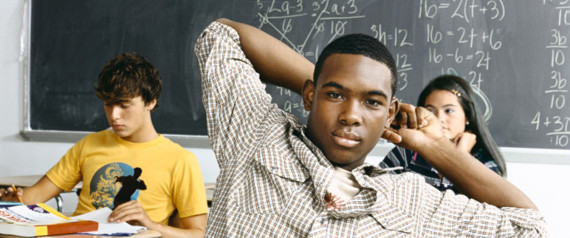
The study showed that teachers tend to view black students more harshly than white students even when their disruptive behavior is exactly the same — possibly triggering a destructive cycle.
“We have shown experimentally, for the first time, that teacher responses can contribute to racial disparities in discipline,” the researchers wrote in a paper describing their research, which was published online April 8 in the journal Psychological Science. “In fact, teacher responses may even help to drive racial differences in student behavior — differential treatment by teachers, to some extent, may inspire repeated misbehavior by black students.”
For the study, a racially diverse group of more than 250 teachers were shown records that described two minor infractions committed by a student. Half of the records were labeled with stereotypically black names (such as Deshawn or Darnell), and half with stereotypically white names (such as Greg or Jake).
After reading about each infraction, the teachers were asked how bothered they were the student’s misbehavior, how severely they thought the student should be disciplined, and how likely they were to consider the student a “troublemaker.”
…When it came to a student’s first infraction, there was no difference in the teachers’ attitudes toward the white and black students. After reading about a second infraction, however, the teachers were more likely to feel troubled by the black students’ behavior, to want to mete out severe punishment, and to label the student a troublemaker.
…The researchers argue in their paper that when a student has multiple infractions, negative racial stereotypes are more likely to kick in. Teachers are more likely to see the infractions of black students as fitting into a larger pattern of bad behavior.
“It’s not that these are racist people, it’s just that we all are exposed to stereotypes in the world,” Jason Okonufua, a graduate student at the university and the study’s lead researcher, told Reuters.
The researchers call this phenomenon the “black-escalation effect.” And they say it’s the same thing that happens outside the classroom.
…The researchers said they hope their findings will encourage the development of new psychological interventions to mitigate the problem…
Read the full article here.
Read more Breaking News here.
Comments Are Welcome
Note: We moderate submissions in order to create a space for meaningful dialogue, a space where museum visitors – adults and youth –– can exchange informed, thoughtful, and relevant comments that add value to our exhibits.
Racial slurs, personal attacks, obscenity, profanity, and SHOUTING do not meet the above standard. Such comments are posted in the exhibit Hateful Speech. Commercial promotions, impersonations, and incoherent comments likewise fail to meet our goals, so will not be posted. Submissions longer than 120 words will be shortened.
See our full Comments Policy here.