What a Surprise! AP poll: A slight majority of Americans are now expressing negative view of blacks
Share
Explore Our Galleries









Breaking News!
Today's news and culture by Black and other reporters in the Black and mainstream media.
Ways to Support ABHM?
By SONYA ROSS and JENNIFER AGIESTA, Associated Press
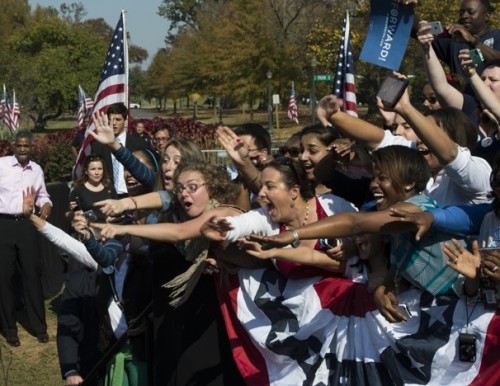
WASHINGTON — Racial attitudes have not improved in the four years since the United States elected its first black president, an Associated Press poll finds, as a slight majority of Americans now express prejudice toward blacks whether they recognize those feelings or not. Those views could cost President Barack Obama votes as he tries for re-election, the survey found, though the effects are mitigated by some people’s more favorable views of blacks.
A Washington Post – ABC News poll looks at who likely voters say they would vote for if the election were held today. Also, how those opinions vary among voter groups, and who voters trust more for different aspects of the job.
Racial prejudice has increased slightly since 2008 whether those feelings were measured using questions that explicitly asked respondents about racist attitudes, or through an experimental test that measured implicit views toward race without asking questions about that topic directly….
In all, 51 percent of Americans now express explicit anti-black attitudes, compared with 48 percent in a similar 2008 survey.
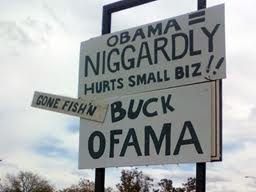
Homemade sign during election 2012 is, unfortunately, not rare.
When measured by an implicit racial attitudes test, the number of Americans with anti-black sentiments jumped to 56 percent, up from 49 percent during the last presidential election. In both tests, the share of Americans expressing pro-black attitudes fell.
Most Americans expressed anti-Hispanic sentiments, too….
The AP surveys were conducted with researchers from Stanford University, the University of Michigan and NORC at the University of Chicago.
“Part of it is growing polarization within American society,” said Fredrick Harris, director of the Institute for Research in African-American Studies at Columbia University. “The last Democrat in the White House said we had to have a national discussion about race. There’s been total silence around issues of race with this president. But, as you see, whether there is silence, or an elevation of the discussion of race, you still have polarization. It will take more generations, I suspect, before we eliminate these deep feelings.”
Curator’s Note: The headline about the “majority of Americans” seems to imply that either the Americans tested all were white or that lots of people of color have come to hate blacks. If the first case is true, why didn’t the AP use “white Americans” in the title? If it’s the second, why did the AP not comment on this unusual finding? I suspect that the AP editors unconsciously assume that the real “Americans” in this country are white.
Read more here.
Anti-Black sentiment survives in modern society.
More breaking news here.
Comments Are Welcome
Note: We moderate submissions in order to create a space for meaningful dialogue, a space where museum visitors – adults and youth –– can exchange informed, thoughtful, and relevant comments that add value to our exhibits.
Racial slurs, personal attacks, obscenity, profanity, and SHOUTING do not meet the above standard. Such comments are posted in the exhibit Hateful Speech. Commercial promotions, impersonations, and incoherent comments likewise fail to meet our goals, so will not be posted. Submissions longer than 120 words will be shortened.
See our full Comments Policy here.