Trailblazing Black and Indigenous sculptor left her mark on Boston
Share
Explore Our Galleries









Breaking News!
Today's news and culture by Black and other reporters in the Black and mainstream media.
Ways to Support ABHM?
Arielle Gray, WBUR
At Mount Auburn Cemetery, on the Cambridge-Watertown line, there’s a hill at the bend of a path. On top is a sculpture that marks the family plot of Dr. Harriet Hunt, the first woman to practice medicine professionally.
The sculpture depicts Hygeia, the Greek goddess of health and hygiene. Time and the harsh New England elements have weathered away her face, and some green lichen is slowly spreading across the marble. But there’s still evidence of the chisel marks made by the person who sculpted Hygeia — an artist named Edmonia Lewis.
“ The sculpture is carved out of beautiful, soft, white Italian Carrara marble,” said Meg Winslow, curator at Mount Auburn Cemetery. “ One thing that’s very unusual about Hygeia is that no one knew it was important because we didn’t have any archives about the statue.”
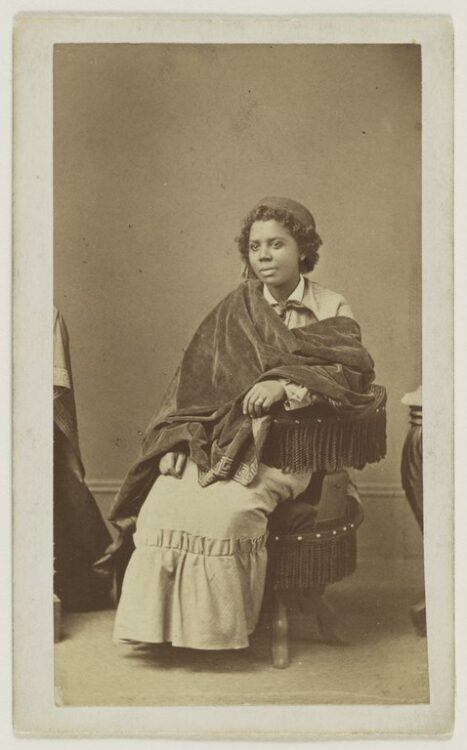
It’s not a surprising fact. Lewis rose to fame in the late 19th century as the first renowned Black and Indigenous sculptor. But after her death and burial in an unmarked grave in 1907, she veritably disappeared from history.
Lewis’s work and life are now the subject of a new exhibition at the Peabody Essex Museum. “Edmonia Lewis: Said In Stone” showcases her sculptures and other artifacts that were contemporary in her lifetime, like paintings and Ojibwe artisan wares.
The original article has more information.
Comments Are Welcome
Note: We moderate submissions in order to create a space for meaningful dialogue, a space where museum visitors – adults and youth –– can exchange informed, thoughtful, and relevant comments that add value to our exhibits.
Racial slurs, personal attacks, obscenity, profanity, and SHOUTING do not meet the above standard. Such comments are posted in the exhibit Hateful Speech. Commercial promotions, impersonations, and incoherent comments likewise fail to meet our goals, so will not be posted. Submissions longer than 120 words will be shortened.
See our full Comments Policy here.