Tonight: Premiering on BET, “The Book of Negroes” mini-series
Share
Explore Our Galleries









Breaking News!
Today's news and culture by Black and other reporters in the Black and mainstream media.
Ways to Support ABHM?
By Tambey A. Obenson, Shadow and Act
What Critics Are Saying About ‘The Book of Negroes’ Miniseries, Which Premieres Tonight on BET
Earlier this month, I wrote and published a piece on BET’s first-ever chances at Emmy nominations this year with 2 scripted series in “Being Mary Jane” and “The Book of Negroes.”
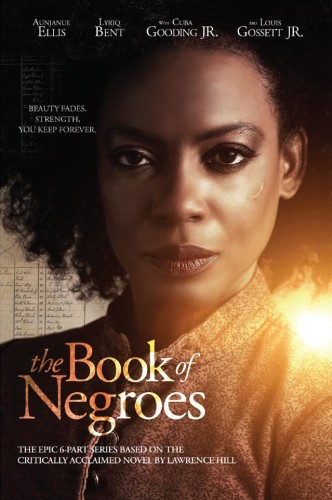
The jury is still out on the former, but, based on reviews I’ve read thus far about the latter, Emmy recognition might be within grasp. Even if not a win, at least a nomination, whether for the miniseries as a whole, or for its star, Aunjanue Ellis, who is receiving much praise for her performance, essentially carrying the show.
It’s finally here, almost 2 years after the project’s initial announcement – BET launches its first-ever event miniseries “The Book of Negroes,” a six-part historical drama in the tradition of “Roots,” based on Lawrence Hill’s award-winning, Oprah Winfrey-listed novel (known in the United States as “Someone Knows My Name”). The highly anticipated television event will run over the course of three consecutive nights in two-hour installments, starting tonight, Monday, February 16, 2015 at 8 PM ET/PT.
Director Clement Virgo’s adaptation stars Aunjanue Ellis as Aminata Diallo, abducted as an 11-year-old child from her village in Sierra Leone (West Africa), is sent to live as a slave in South Carolina, and years later, forges her way to freedom, serving the British in the Revolutionary War and registering her name in the historic “Book of Negroes” – an actual document that provides a short but immensely revealing record of freed Loyalist slaves who requested permission to leave the US for resettlement in Nova Scotia, only to find that the haven they sought was steeped in an oppression all of its own.
That this is a story told solely from the perspective of a woman, separates it from most slave narratives.
“It’s a universal story of a legendary woman. There’s loss, a long journey and triumph,” said Debra L. Lee, CEO of BET Networks. “It’s very exciting for us for ‘Book of Negroes’ to be our first miniseries… My vision for BET is to be a well-rounded network. There are so many stories in our culture to tell, and I’m so proud of this. I’m hoping that it’s ‘Roots’ for a younger generation.”
Read more Breaking News here.
Comments Are Welcome
Note: We moderate submissions in order to create a space for meaningful dialogue, a space where museum visitors – adults and youth –– can exchange informed, thoughtful, and relevant comments that add value to our exhibits.
Racial slurs, personal attacks, obscenity, profanity, and SHOUTING do not meet the above standard. Such comments are posted in the exhibit Hateful Speech. Commercial promotions, impersonations, and incoherent comments likewise fail to meet our goals, so will not be posted. Submissions longer than 120 words will be shortened.
See our full Comments Policy here.