This Day in Black History: Civil Rights Leader Medgar Evers is Born
Share
Explore Our Galleries









Breaking News!
Today's news and culture by Black and other reporters in the Black and mainstream media.
Ways to Support ABHM?
From the African American Registry
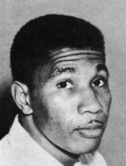
Medgar Evers was born on this date in 1925 in Decatur, Mississippi. He was an African-American civil rights leader whose assassination for his work as field secretary for the NAACP in Mississippi galvanized the Civil Rights Movement.
As a representative of the NAACP, Evers worked for the most established and in some ways most conservative African-American membership organization. He was, by all accounts, a hardworking, thoughtful, and somewhat quiet man. Yet the work Evers did was groundbreaking, even radical, in that he risked (and eventually lost) his life bringing news of his state’s violent white supremacy to nationwide attention. When Byron De la Beckwith, a white racist, assassinated Evers in his front yard, he became a symbol of the brutality with which the old South resisted the Civil Rights Movement. Raised in a small central Mississippi town, Evers absorbed his parents’ work ethic and strong religious values early in his life. Friends, including his brother, Charles, remember him as a serious child with an air of maturity about him.
Read more about Evers here.
Comments Are Welcome
Note: We moderate submissions in order to create a space for meaningful dialogue, a space where museum visitors – adults and youth –– can exchange informed, thoughtful, and relevant comments that add value to our exhibits.
Racial slurs, personal attacks, obscenity, profanity, and SHOUTING do not meet the above standard. Such comments are posted in the exhibit Hateful Speech. Commercial promotions, impersonations, and incoherent comments likewise fail to meet our goals, so will not be posted. Submissions longer than 120 words will be shortened.
See our full Comments Policy here.