This Day in Black History: Buffalo Soldiers Unit Created
Share
Explore Our Galleries









Breaking News!
Today's news and culture by Black and other reporters in the Black and mainstream media.
Ways to Support ABHM?
From the African American Registry
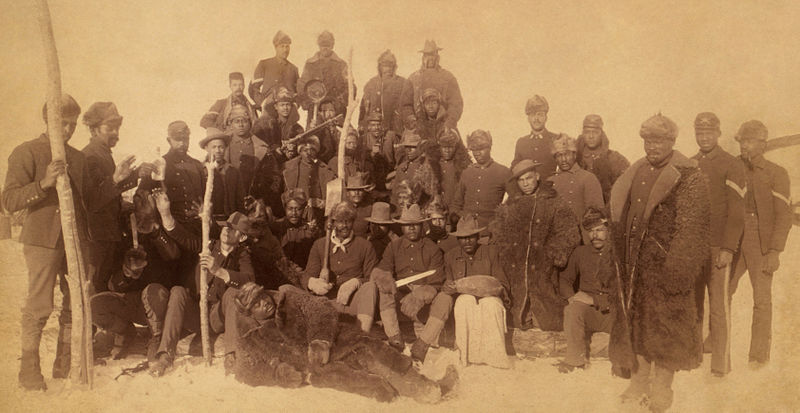
On June 28, 1866, an Act of Congress authorized the creation of two cavalry and four infantry regiments, “which shall be composed of colored men.” They were organized as the 9th and 10th Cavalry and the 38th through 41st Infantry.
The 9th and 10th Cavalry would go on to play a major role in the history of the West, as the “Buffalo Soldiers”
These were the Buffalo Soldiers, members of African-American cavalry regiments of the U.S. Army who served in the western United States until 1896, mainly fighting Indians on the frontier. On September 21, 1866, the 9th Cavalry Regiment was activated at Greenville, LA, under command of Colonel Edward Hatch, and the 10th Cavalry Regiment at Fort Leavenworth, KS, under command of Colonel Benjamin
Grierson. the 38th through 41st infantries (these four were later reduced to the 24th and 25 infantries), which often fought alongside the cavalry regiments. The congressional order required their officers to be white.
Read more of the story here.
You can read about more Black history in our online exhibits.
More Black news here.
Comments Are Welcome
Note: We moderate submissions in order to create a space for meaningful dialogue, a space where museum visitors – adults and youth –– can exchange informed, thoughtful, and relevant comments that add value to our exhibits.
Racial slurs, personal attacks, obscenity, profanity, and SHOUTING do not meet the above standard. Such comments are posted in the exhibit Hateful Speech. Commercial promotions, impersonations, and incoherent comments likewise fail to meet our goals, so will not be posted. Submissions longer than 120 words will be shortened.
See our full Comments Policy here.