How Theodore Roosevelt and American Democracy was Influenced by Buganda: The Real Wakanda
Share
Explore Our Galleries









Breaking News!
Today's news and culture by Black and other reporters in the Black and mainstream media.
Ways to Support ABHM?
Jonathon L. Earle, Politico
Wakanda, the fictional kingdom portrayed in the Marvel cinematic universe has a real-life antecedent — and its legacy reverberates throughout American and European history.
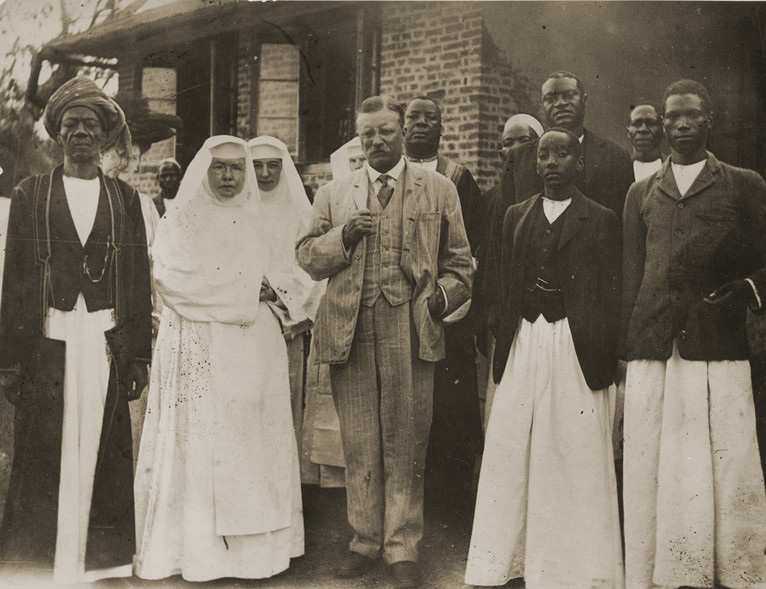
“When former American President Theodore Roosevelt reached the east African kingdom of Buganda near the end of his epic 1909 safari, he expected to find more of what he already knew: exotic animals to hunt and an African landscape filled with ‘wild savages,’ as he wrote in a letter to a friend. But what he discovered instead on that Christmas Eve was something extraordinary: one of the most politically and socially sophisticated monarchies in the world, a real-life kingdom that could have been a model for the fictional Wakanda. Buganda — geographically located near its Marvel counterpart in sub-Saharan east Africa — changed the course of American democracy.
[…]
Throughout his expedition to Africa, he had cultivated relationships with the African porters who were his companions. His closeness to them increased along with his appreciation for Africans generally. In years to come, he wrote about his longing to see them again. Roosevelt had spent much of his leisurely time socializing with the porters. As they ate, traveled, prayed, hunted, forded rivers and rested together, Roosevelt began questioning his earlier assumptions about Black histories and societies, even before he reached the high courts of Buganda. And his survival relied almost entirely on porters’ knowledge of the natural world.
[…]
But [Theodore] Roosevelt was not the only person thinking about the kingdom of Buganda […]. W.E.B. Du Bois founded the Crisis in November 1910. It was the official publication of the NAACP. In the issue just before the election, the magazine featured Buganda and Kabaka Chwa II, who was declared the magazine’s Man of the Month. The NAACP presented Kabaka Chwa II and Baganda as exemplars of Black progress and citizenship. Buganda’s ‘Black Boy who is King … rules over 4,000,000 black folk in a territory as large as New England, New York, and Pennsylvania combined.’ Historians of the NAACP returned to the deep past, showing readers and voters how the ‘first modern king of Uganda … ascended the throne about 1400, and was contemporary with Henry IV of England and Joan of Arc.’ The lessons were clear: Black histories were just as vast and complex as anything in Europe or the New World. Buganda embodied Black progress in a world of discriminating politics, and it was high time to claim a similar reality in America.
Three of the World’s Most Influential Empires: Ghana, Mali, and Songhai
Comments Are Welcome
Note: We moderate submissions in order to create a space for meaningful dialogue, a space where museum visitors – adults and youth –– can exchange informed, thoughtful, and relevant comments that add value to our exhibits.
Racial slurs, personal attacks, obscenity, profanity, and SHOUTING do not meet the above standard. Such comments are posted in the exhibit Hateful Speech. Commercial promotions, impersonations, and incoherent comments likewise fail to meet our goals, so will not be posted. Submissions longer than 120 words will be shortened.
See our full Comments Policy here.