The Marines were last to integrate. Here are the stories of the first Black recruits.
Share
Explore Our Galleries









Breaking News!
Today's news and culture by Black and other reporters in the Black and mainstream media.
Ways to Support ABHM?
By Rachel Jones, National Geographic
80 years after the Montford Point Camp was established to train enlisted African Americans, relatives and other Marines fight to document their contributions before it’s too late.
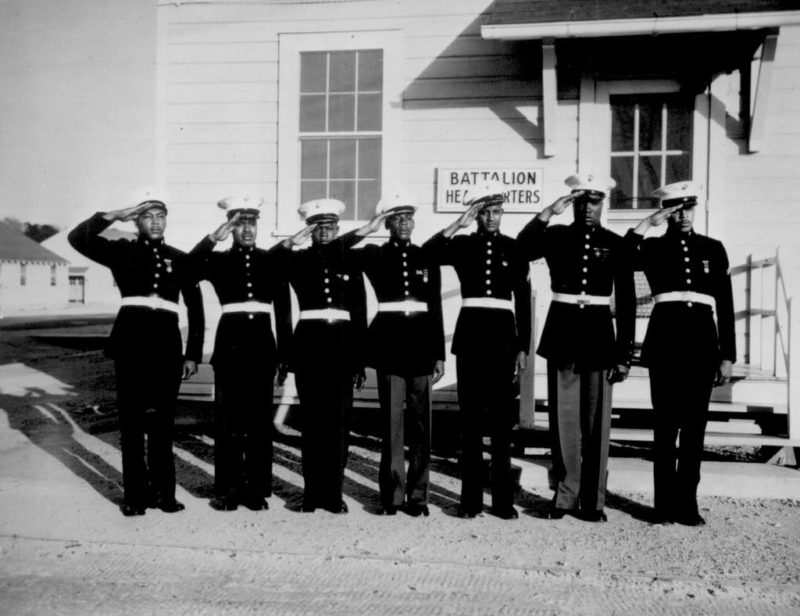
JACKSONVILLE, NORTH CAROLINAThe first thing Carroll William Braxton remembers about June of 1943 is the heat. It was hot in Manassas, Virginia when he and two buddies caught a train to Quantico, and then another to Jacksonville, North Carolina. Braxton was 18, and as World War II engulfed more of America’s mental and physical bandwidth, he didn’t want to wait to be drafted. He wanted one of those sharp, blue uniforms sported by United States Marines.
Then came the scorching abuse.
“They made us line up and empty our pockets, and shouted, ‘We don’t want those knives in here,’ I guess they thought we always had knives, you know,” Braxton says. “And I remember I was wearing a hat, and this MP threw it on the ground and stomped on it. And he proceeded to call me every kind of “n—-r’ you can think of, and it seems like he was never going to stop.”
The 98-year-old’s shared memory of this experience comes in late August while he’s seated in what was once the mess hall for recruits at the former Montford Point Marines Training Camp. Established in 1942, the building was decommissioned in 1949 and is now part of a museum honoring the service of approximately 20,000 men who became the first Black recruits in the U.S. Marines Corps.
On this recent summer day, Braxton and four other original Montford Point Marines donned their blue woolen jackets adorned with ribbons and medals, and blue hats with red piping and gold lettering. They sat in the first row of metal folding chairs. Some gripped canes, others needed no assistance to stand at attention. All now in their mid to late-90’s, they were joined by the families of 11 other men who had trained at what is now known as Camp Johnson, a satellite school for the nearby Camp Lejeune.
During the 57th annual convention of the National Montford Point Marine Association, Inc., family members received bronze replicas of the Congressional Gold Medal that was originally awarded to those history-making recruits in 2012.
But 80 years after the Montford Point Camp was carved out of a swampy woody 1,600-acre peninsula near Jacksonville, many of those who followed those recruits are in a race against time. They want more men like Braxton to know that their service is lauded in the same vein as the 54th Massachusetts Infantry Regiment, the Buffalo Soldiers, or the Tuskeegee Airmen, aka the “Red Tails.”
“We estimate there are about 16,000 names that we still haven’t been able to locate and verify,” says the association’s president, James Averhart, Jr., a retired chief warrant officer 5. “That’s 16,000 families who may not realize the sacrifice and service of a father or grandfather. It is an inherent obligation that we identify these individuals and acknowledge their service.”
Find images of Black service members in this Veteran’s Day post.
Comments Are Welcome
Note: We moderate submissions in order to create a space for meaningful dialogue, a space where museum visitors – adults and youth –– can exchange informed, thoughtful, and relevant comments that add value to our exhibits.
Racial slurs, personal attacks, obscenity, profanity, and SHOUTING do not meet the above standard. Such comments are posted in the exhibit Hateful Speech. Commercial promotions, impersonations, and incoherent comments likewise fail to meet our goals, so will not be posted. Submissions longer than 120 words will be shortened.
See our full Comments Policy here.