The American Revolution was not a whites-only war
Share
Explore Our Galleries









Breaking News!
Today's news and culture by Black and other reporters in the Black and mainstream media.
Ways to Support ABHM?
By Colbert I. King, the Washington Post
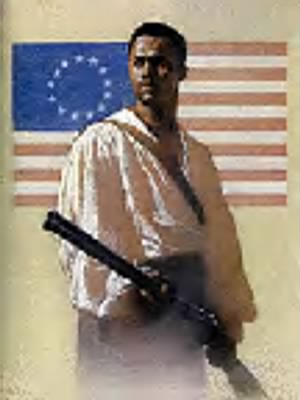
There are aspects of the American Revolution that are neither well known nor appreciated.
[..T]he American Revolution, although not fought on behalf of slaves, was not a whites-only undertaking.
The political freedom resulting from the war was earned on battlefields at Lexington and Concord, at the Battle of Bunker Hill and beyond, with the help of black soldiers, both free and enslaved, who fought with the Continental Army.
The Revolutionary War victory was every bit theirs, as well.
At least 20 blacks were among the ranks of the rebels when the British launched their attack on the American position outside Boston in the Battle of Bunker Hill.
Peter Salem, born a slave in Framingham, Mass., earned his stripes as a minuteman fighting at Concord and later at Bunker Hill. Salem is credited with firing the shot that killed British Maj. John Pitcairn, who led the Redcoats when they attacked at Lexington.
Salem fought in other battles, and after the war, lived in a cabin and worked as a cane weaver. He died in a Framingham poorhouse in 1862. Twenty years later, the town erected a monument in his honor.
Former slave Salem Poor was also at the Battle of Bunker Hill. His service drew the praise of 14 officers who petitioned the Massachusetts legislature to grant him a reward[.] It was not to be. Poor died in a Boston shelter for the homeless in 1802.
Saul Matthews was a slave when he enlisted as a soldier in the Virginia militia, according to the Colonial Williamsburg Foundation. Matthews served as a spy, undertaking missions into British camps to collect information on troop positions and movements. He, too, drew praise from top leaders of the Revolution.
When the war ended, Matthews was returned to slavery for nearly 10 years. He petitioned the Virginia General Assembly for his freedom. It was granted in 1792.
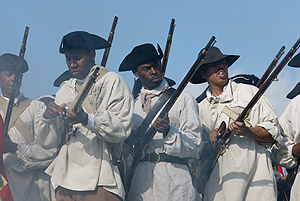
The 1st Rhode Island Regiment, called the “Black Regiment” because of its large number of African American soldiers, engaged in five years of fighting in New York, New Jersey and Virginia.
After the war, as the Army’s official Web site reports, some black soldiers, like those who served in the 1st Rhode Island, went on to live as freed men. However, many others, after having fought for freedom, were returned to slavery…
The nation should salute them, too.
Read the full article here.
Read more Breaking News here.
Comments Are Welcome
Note: We moderate submissions in order to create a space for meaningful dialogue, a space where museum visitors – adults and youth –– can exchange informed, thoughtful, and relevant comments that add value to our exhibits.
Racial slurs, personal attacks, obscenity, profanity, and SHOUTING do not meet the above standard. Such comments are posted in the exhibit Hateful Speech. Commercial promotions, impersonations, and incoherent comments likewise fail to meet our goals, so will not be posted. Submissions longer than 120 words will be shortened.
See our full Comments Policy here.