The 120th Anniversary of Lift Ev’ry Voice and Sing
Share
Explore Our Galleries









Breaking News!
Today's news and culture by Black and other reporters in the Black and mainstream media.
Ways to Support ABHM?
On Feb. 12, 1900, Lift Ev’ry Voice and Sing was performed by school children in Jacksonville, Fla. The song’s author was James Weldon Johnson, a renaissance man who was an educator, lawyer, novelist and activist. Johnson initially imagined Lift Ev’ry Voice and Sing as a poem that would celebrate the birthday of Abraham Lincoln. But on the page it became something else.
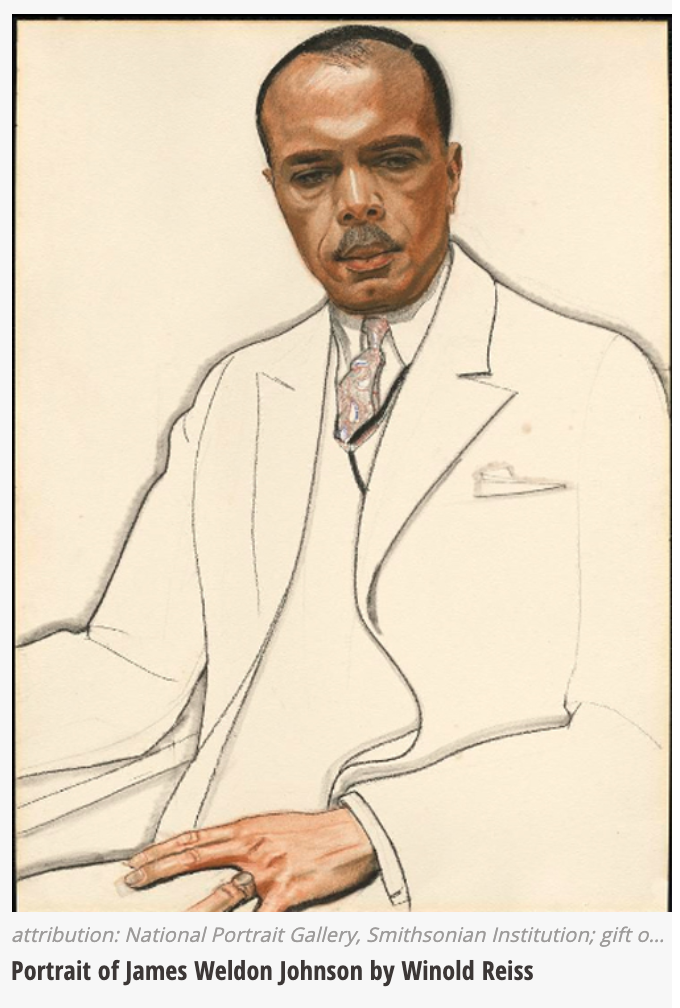
Johnson’s lyrics told the story of Black life in terms that were epic, wrenching, and thunderous. It was in the same tradition as famed abolitionist Frederick Douglass, who, like most enslaved children, hadn’t had his birth date recorded. However, he’d chosen Feb. 14 as the day on which he would celebrate his birth, two days after Lincoln’s. Douglass’ classic, Narrative of the Life of Frederick Douglass, told the story of his journey from slavery to freedom with drama, passion, breathtaking emotion and stunning brilliance.
Johnson’s poem did something quite similar. He recalled his writing process: “A group of young men decided to hold on February 12th a celebration in honor of Lincoln’s birthday. I was put down for an address, which I began preparing, but I wanted to do something else also. My thoughts began buzzing round a central idea of writing a poem about Lincoln but I couldn’t net them. So I gave up the project as beyond me…My central idea, however, took on another form. I talked over with my brother the thought I had in mind and we planned to write a song to be sung as part of the exercises. We planned better still to have it sung by school children, a chorus of 500 voices…”
Read the full article here.
To view the full lyrics of the poem click here.
Comments Are Welcome
Note: We moderate submissions in order to create a space for meaningful dialogue, a space where museum visitors – adults and youth –– can exchange informed, thoughtful, and relevant comments that add value to our exhibits.
Racial slurs, personal attacks, obscenity, profanity, and SHOUTING do not meet the above standard. Such comments are posted in the exhibit Hateful Speech. Commercial promotions, impersonations, and incoherent comments likewise fail to meet our goals, so will not be posted. Submissions longer than 120 words will be shortened.
See our full Comments Policy here.