Teddy Bears and Racial Justice: How St. Louis Became a Laboratory for Social Work
Share
Explore Our Galleries









Breaking News!
Today's news and culture by Black and other reporters in the Black and mainstream media.
Ways to Support ABHM?
By Blake Hounshell, New York Times
Politicians, activists and entrepreneurs are trying to solve the city’s deep racial and economic divides — and their ambitions know few boundaries.
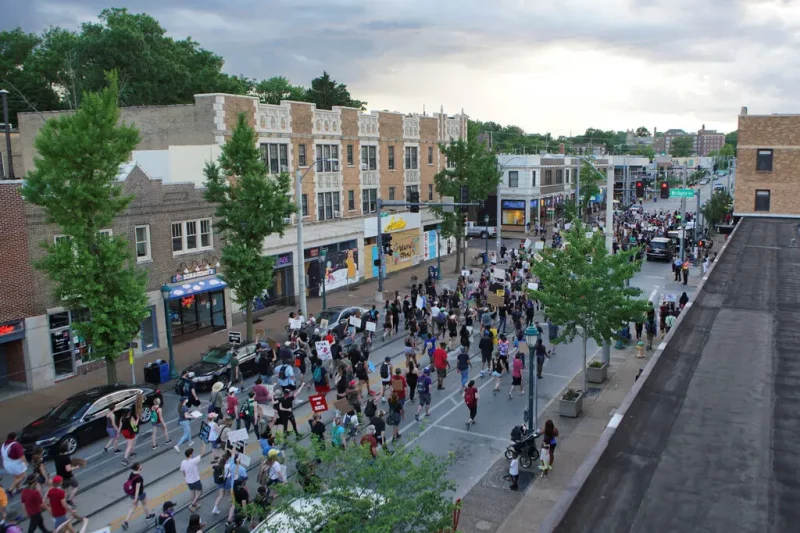
It’s called the Delmar Divide, named for the once-grand boulevard that bisects this city into enclaves that have long been more starkly segregated than almost anywhere else in America.
North of Delmar Boulevard lies an expanse of low-income, predominantly Black neighborhoods whose struggles with violence have given St. Louis its reputation as one of the perennial murder capitals of America, alongside more diverse, middle-class outposts like University City that have produced Black celebrities including the rapper Nelly and the basketball stars Jayson Tatum and Bradley Beal. In some especially troubled areas, repossessed homes can be picked up for as little as $1.
In wealthier, mostly white areas just south of Delmar, stately Gilded Age mansions listed in the millions of dollars line privately managed, manicured streets that contrast sharply with the dilapidated rowhouses mere blocks away.
It was just off Delmar Boulevard, in a gated neighborhood within Central West End, that one of the most revealing episodes of the 2020 protest movement for racial justice took place.
[…]
St. Louis is also undergoing political and social change: Tishaura Jones, the first Black woman to be elected mayor, took office in April 2021.
Jones has allied herself with a new progressive majority on the board of aldermen and with Cori Bush, who represents the city in Congress and is close to the so-called Squad in Washington.
The rise of this left-leaning governing coalition has led to grumbling within the mainly white old guard of the local Democratic Party establishment, who see the newcomers as interlopers who don’t understand what the city needs to thrive economically.
But it has also injected fresh momentum into efforts to address the legacy of what Sylvester Brown Jr., who was a longtime columnist for The St. Louis Post-Dispatch, calls “Uncle Ray”: the indelible legacy of race and racism.
Finish Hounshell’s article about St. Louis.
Perhaps unsurprisingly, both the city’s jail and police have been criticized of racism.
As communities grapple with racism, we’ll include these stories in our breaking news.
Comments Are Welcome
Note: We moderate submissions in order to create a space for meaningful dialogue, a space where museum visitors – adults and youth –– can exchange informed, thoughtful, and relevant comments that add value to our exhibits.
Racial slurs, personal attacks, obscenity, profanity, and SHOUTING do not meet the above standard. Such comments are posted in the exhibit Hateful Speech. Commercial promotions, impersonations, and incoherent comments likewise fail to meet our goals, so will not be posted. Submissions longer than 120 words will be shortened.
See our full Comments Policy here.