Supreme Court unfreezes Louisiana redistricting case that could boost Black voting power before 2024
Share
Explore Our Galleries









Breaking News!
Today's news and culture by Black and other reporters in the Black and mainstream media.
Ways to Support ABHM?
By Kevin McGill, Mark Sherman and Sara Cline, AP News
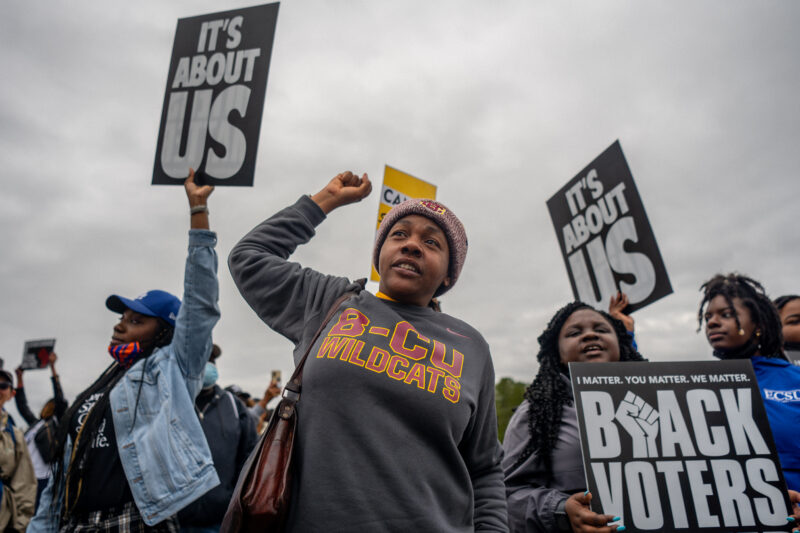
The Supreme Court on Monday lifted its hold on a Louisiana political remap case, increasing the likelihood that the Republican-dominated state will have to redraw boundary lines to create a second mostly Black congressional district.
For more than a year, there has been a legal battle over the GOP-drawn political boundaries, with a federal judge, Democratic Gov. John Bel Edwards and opponents saying that the map is unfair and discriminates against Black voters.
The map, which was used in Louisiana’s November congressional election, has white majorities in five of six districts, all currently held by Republicans. This is despite Black people accounting for one-third of the state’s population. Another mostly Black district could deliver another congressional seat to Democrats.
“I’m super excited,” said Ashley Shelton, head of the Louisiana-based Power Coalition for Equity and Justice, one of the groups challenging the maps. “What this does is it puts us back on track to realize a second majority-minority district.”
In a written statement, the Louisiana Legislative Black Caucus said, while work still needs to be done, it is “very confident” the state will have two majority-Black districts by the 2024 congressional election.
Read more about the Supreme Court case in the original article.
Learn more about modern-day segregation, directly connected to political district boundaries, in this virtual exhibit.
Find more Breaking News here.
Comments Are Welcome
Note: We moderate submissions in order to create a space for meaningful dialogue, a space where museum visitors – adults and youth –– can exchange informed, thoughtful, and relevant comments that add value to our exhibits.
Racial slurs, personal attacks, obscenity, profanity, and SHOUTING do not meet the above standard. Such comments are posted in the exhibit Hateful Speech. Commercial promotions, impersonations, and incoherent comments likewise fail to meet our goals, so will not be posted. Submissions longer than 120 words will be shortened.
See our full Comments Policy here.