St. Louis Neighborhood Erupts Following Fatal Officer-Involved Shooting
Share
Explore Our Galleries









Breaking News!
Today's news and culture by Black and other reporters in the Black and mainstream media.
Ways to Support ABHM?
By Mariah Stewart, the Huffington Post and Rebecca Rivas, The St. Louis American
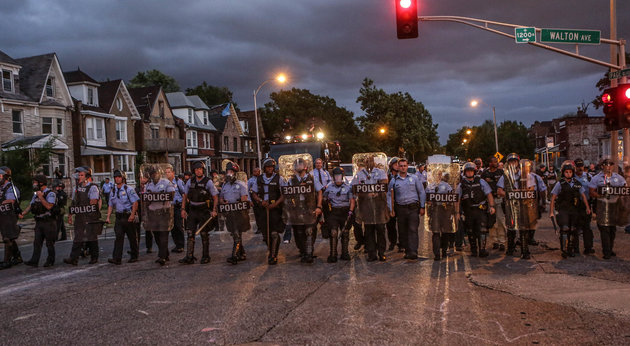
Heavily armed police deployed tear gas into a North St. Louis City residential neighborhood Wednesday night in an attempt to quell protests that incited after city police shot and killed an 18-year-old black man, Mansur Bell-Bey.
Police made nine arrests at the protest, seven men and two women. All were charged with impeding the flow of traffic, and one woman was charged with resisting arrest.
At around 11:30 a.m., St. Louis city police were executing a search warrant at a home on Walton Road near Page Avenue in the Fountain Park neighborhood. Two black men ran out the back, both armed, police said. Two officers were waiting in the alley and one of the suspects pointed his gun at police, according to police. The officers then shot and killed Ball-Bey.
[…]
Soon after the incident, people gathered peacefully in the street, though tensions were high and the community was frustrated. A few bellowed protest chants and some blocked the intersection…
Around 3 p.m., a militarized police vehicle arrived with police in riot gear, according to activist Tony Rice, who posted photos on Twitter and remained at the site throughout the evening.
At that point, police were able to coral the crowd onto the sidewalks, said St. Louis Police Chief Sam Dotson in a press briefing Wednesday night. Police made two arrests, and “peace was restored,” he said.
However, the two arrests angered the crowd, especially because the second man arrested appeared to be a senior citizen. The crowd also did not understand why the armed vehicles and men were present, some told the St. Louis American.
[…]
Some individuals threw rocks, bricks and water bottles at police officers, Dotson said. According to a video the police released, police formed a uniform line to protect themselves.
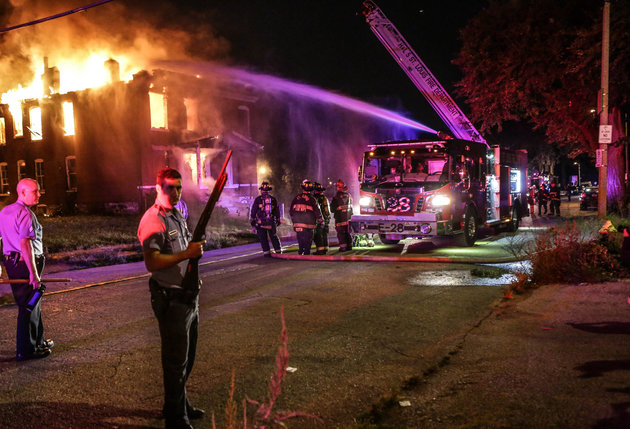
After the crowd refused to disperse, Dotson said, “smoke was used, like you see at the Fourth of July.” Then they teargassed the area. Rice tweeted that they did not give warnings before the teargas, and some individuals were sitting on their porches.
[…]
At around noon that day, people had gathered downtown for a march and vigil for Kajieme Powell, a 25-year-old who was fatally shot by St. Louis Police exactly one year before.
Protest organizer Kayla Reed and other attendees of the vigil, left their demonstration in front of St. Louis Circuit Attorney Jennifer Joyce’s office to arrive on the scene at the intersection of Page and Walton.
At the vigil, she said, “I sincerely believe St. Louis was chosen for everything to happen here because of the racial divide in this region and because it’s in the heart of the country.”
Read the full article here.
Read more Breaking News here.
Comments Are Welcome
Note: We moderate submissions in order to create a space for meaningful dialogue, a space where museum visitors – adults and youth –– can exchange informed, thoughtful, and relevant comments that add value to our exhibits.
Racial slurs, personal attacks, obscenity, profanity, and SHOUTING do not meet the above standard. Such comments are posted in the exhibit Hateful Speech. Commercial promotions, impersonations, and incoherent comments likewise fail to meet our goals, so will not be posted. Submissions longer than 120 words will be shortened.
See our full Comments Policy here.