Special News Series: Rising Up For Justice! – Police deployed potentially lethal chemical during Black Lives Matter protests
Share
Explore Our Galleries









Breaking News!
Today's news and culture by Black and other reporters in the Black and mainstream media.
Ways to Support ABHM?
Introduction To This Series:
This post is one installment in an ongoing news series: a “living history” of the current national and international uprising for justice.
Today’s movement descends directly from the many earlier civil rights struggles against repeated injustices and race-based violence, including the killing of unarmed Black people. The posts in this series serve as a timeline of the uprising that began on May 26, 2020, the day after a Minneapolis police officer killed an unarmed Black man, George Floyd, by kneeling on his neck. The viral video of Floyd’s torturous suffocation brought unprecedented national awareness to the ongoing demand to truly make Black Lives Matter in this country.
The posts in this series focus on stories of the particular killings that have spurred the current uprising and on the protests taking place around the USA and across the globe. Sadly, thousands of people have lost their lives to systemic racial, gender, sexuality, judicial, and economic injustice. The few whose names are listed here represent the countless others lost before and since. Likewise, we can report but a few of the countless demonstrations for justice now taking place in our major cities, small towns, and suburbs.
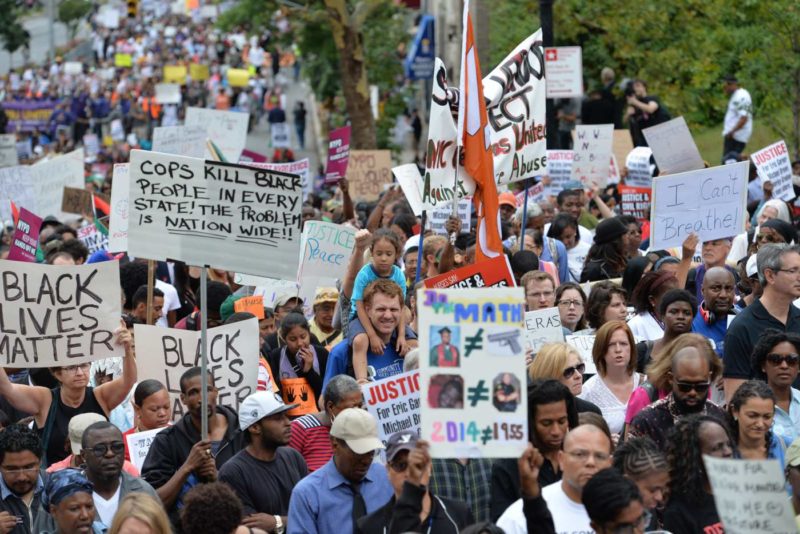
To view the entire series of Rising Up for Justice! posts, insert “rising up” in the search bar above.
Police deployed potentially lethal chemical during Black Lives Matter protests
Laura Jedeed, Salon
February 21, 2021
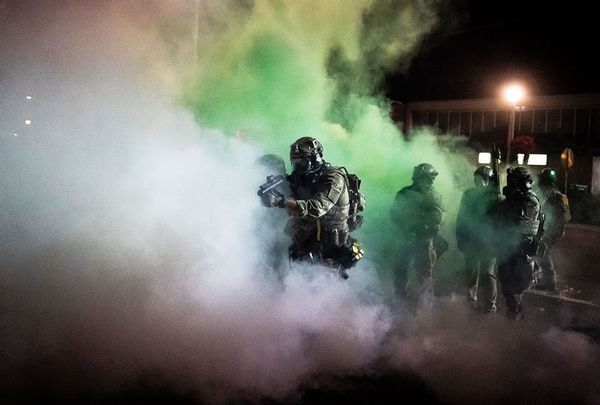
For $33, you can buy a Defense Technologies hexachloroethane (HC) smoke canister for crowd control purposes. This is what the City of Milwaukee paid per unit for 60 “Max Smoke” canisters in preparation for the Democratic National Convention in August 2020. It is what Portland Police bought in 2018, and what Denver Police likely used on Black Lives Matter (BLM) protesters this summer…
BLM protesters were no strangers to tear gas and smoke — after all, the Portland Police had gassed them many times since the George Floyd protests began in late May. But once the feds arrived, protesters knew almost immediately that something was different. People reported new, strange effects that lasted days or weeks after exposure. “I puked. All night,” Gregory McKelvey, activist and campaign manager for Portland mayoral candidate Sarah Iannarone, tweeted on July 26. “This gas feels different and sneaks up on you.” Other protesters and journalists on the ground reported similar bouts of nausea and vomiting, along with loss of appetite, hair loss and a burning sensation that lasted days after exposure.
Dr. Juniper L. Simonis, a Portland-based ecologist and evolutionary biologist, suspected that a new chemical used by federal agents might explain these troubling ailments. To find out, they collected and tested samples from plants, soil, gas mask filters and protesters’ clothing.
Ultimately, they discovered this chemical, while relatively new to Portland, was not new at all. Nor were its side effects unprecedented. On the contrary, scientists and doctors have known about HC smoke — and its potentially lethal side effects — for nearly a century…
Even if federal agents never again fill the streets with clouds of toxic zinc chloride, the consequences of its prolific deployment may haunt the City of Roses for many years to come. HC smoke releases heavy metals along with zinc chloride. These elements bioaccumulate in livers and kidneys, where they increase the chance of cancer. This kind of damage may not be evident for many years, but those who live downtown or protested for Black Lives in the summer of 2020 may be at higher risk for kidney and liver problems down the road.
None of these solves the root problem, of course: The United States’s routine use of potentially lethal chemical weapons in urban areas, often during peaceful or nonviolent protests, in ways that affect the entire populace as well as the environment. “I plead with all law enforcement agencies who have HC in their arsenal to decommission it immediately,” Simonis said. “There is no reason for any police agency to possess it.”
Read the full article here.
More Breaking News here.
Explore the ABHM galleries here.
Comments Are Welcome
Note: We moderate submissions in order to create a space for meaningful dialogue, a space where museum visitors – adults and youth –– can exchange informed, thoughtful, and relevant comments that add value to our exhibits.
Racial slurs, personal attacks, obscenity, profanity, and SHOUTING do not meet the above standard. Such comments are posted in the exhibit Hateful Speech. Commercial promotions, impersonations, and incoherent comments likewise fail to meet our goals, so will not be posted. Submissions longer than 120 words will be shortened.
See our full Comments Policy here.