Solving the U.S. Black Maternal Health Crisis Could Save Lives and Dollars
Share
Explore Our Galleries









Breaking News!
Today's news and culture by Black and other reporters in the Black and mainstream media.
Ways to Support ABHM?
By Word in Black, Jennifer Porter Gore
Disabilities from maternal health conditions could cause Black women giving birth this year to lose 350,000 healthy life years.
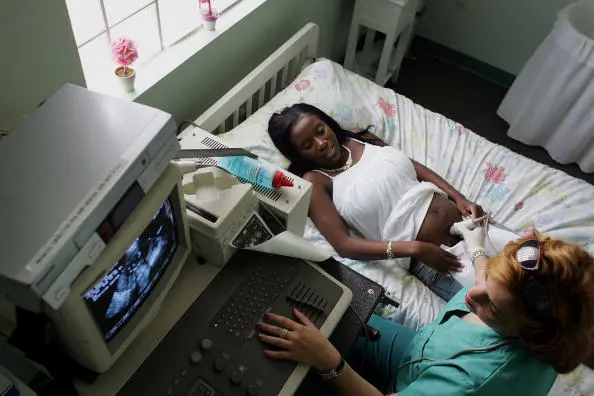
They are well-known facts: the United States has some of the worst maternal and infant mortality rates in the industrialized world, and Black women are two to four times more likely to die in childbirth than white women.
Yet a new report finds that a few key changes to improve Black maternal and newborn health would not only save the lives of more than 3,100 Black mothers and 35,000 Black infants, but also inject an astounding $25 billion into the economy and save $385 million in healthcare costs.
If the changes were implemented today, according to the report from the McKinsey Institute for Economic Mobility, the financial dividends could be seen as early as 2040.
“I’ve always said health is wealth. This report brings dollar signs to the crisis,” says Dr. Faith Ohuoba, OB-GYN Department Chair and Specialty Medical Director at Memorial Hermann Health System in Houston.
“The public sometimes becomes numb to the daunting statistics or may not readily relate to the stories behind the statistics regarding black maternal health,” she says. “[But] these figures aren’t just numbers—they represent lives saved, communities stabilized, and an economy strengthened by investing in Black maternal well-being.”
The Persistent Crisis of Black Maternal and Infant Deaths
Almost a decade ago, data from the Centers for Disease Control and Prevention found that more than 80% of pregnancy-related deaths were preventable. Yet as recently as 2023 — while all other demographic groups saw improvements in maternal death rates after the worst of the Covid-19 pandemic subsided — Black women were the only racial group whose maternal death rate increased.
Dr. Amanda P. Williams, interim medical director for the nonprofit March of Dimes, called the situation “unacceptable.”
“The maternal mortality rate for Black moms has returned to near pre-pandemic levels, with the gap between them and white moms widening from 2.5 times in 2019 to 3.5 times in 2023,” she says. The data “confirms the urgent need for systemic changes to eliminate these inequities in maternal healthcare.”
And the peril doesn’t stop after the baby arrives.
Black infants in the U.S. are more than twice as likely to die before their first birthday compared to infants from most other demographic groups. McKinsey’s analysis shows that closing the Black infant mortality gap could save the lives of 2,885 babies this year alone.
Steps Toward a Solution
According to the McKinsey report, reversing the disproportionately high rate of Black maternal mortality must begin with accurately measuring the extent of the problem since “health systems cannot improve what they do not measure.” That alone, however, is a significant challenge.
As recently as 2019, roughly 15 percent of reported maternal deaths were misclassified on several states’ death certificates, according to the CDC. And the McKinsey report notes that many hospitals and public health systems still keep separate records for mothers and newborns, making it hard to track health outcomes.
Read more on how solving U.S. Black Maternal Death saves money and lives.
Check out our Breaking News section for more Black News.
Check out our black history galleries.
Comments Are Welcome
Note: We moderate submissions in order to create a space for meaningful dialogue, a space where museum visitors – adults and youth –– can exchange informed, thoughtful, and relevant comments that add value to our exhibits.
Racial slurs, personal attacks, obscenity, profanity, and SHOUTING do not meet the above standard. Such comments are posted in the exhibit Hateful Speech. Commercial promotions, impersonations, and incoherent comments likewise fail to meet our goals, so will not be posted. Submissions longer than 120 words will be shortened.
See our full Comments Policy here.