Senate Unanimously Passes Bill Making Lynching a Federal Crime
Share
Explore Our Galleries









Breaking News!
Today's news and culture by Black and other reporters in the Black and mainstream media.
Ways to Support ABHM?
By Mihir Zaveri, The New York Times
The Senate on Wednesday unanimously passed a bill that would, for the first time, explicitly make lynching a federal crime.
“For over a century, members of Congress have attempted to pass some version of a bill that would recognize lynching for what it is: a bias-motivated act of terror,” Senator Cory Booker, a New Jersey Democrat who introduced the bill, said in a statement. “Today, we have righted that wrong and taken corrective action that recognizes this stain on our country’s history.”
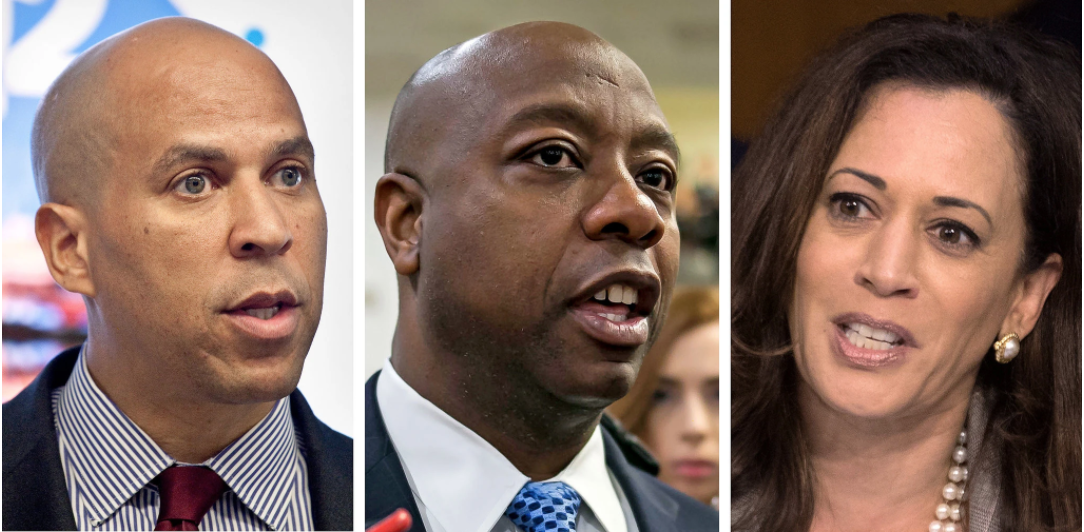
Senators Cory Booker, Tim Scott and Kamala Harris introduced a bill that would make lynching a federal hate crime. A similar bill has been introduced in the House.Credit…From left: Bryan Anselm for The New York Times; Al Drago for The New York Times; Stephen Crowley/The New York Times
More than 4,700 people, the vast majority of them black, were lynched in the United States between 1882 and 1968, according to the N.A.A.C.P. Perpetrators were rarely prosecuted. Congress has tried and failed some 200 times to pass similar anti-lynching legislation since 1882, according to the bill.
The bill, titled the Justice for Victims of Lynching Act of 2018, was introduced in June by the Senate’s three black members: Kamala Harris, a California Democrat; Tim Scott, a South Carolina Republican; and Mr. Booker. A spokeswoman for Ms. Harris said her office was trying to get the House to schedule a vote on the bill before Congress adjourns this week.
“Lynchings were needless and horrendous acts of violence that were motivated by racism,” Ms. Harris said in a statement. “And we must acknowledge that fact, lest we repeat it…”
Frank Pezzella, a professor at the John Jay College of Criminal Justice, said the bill’s passage also carries a message of deterrence — that lynching or actions similar to it will not be tolerated by society. Reported hate crimes rose for the third consecutive year in 2017, according to the F.B.I.
“It was taken for granted in the South that whites could use force against any African-Americans who became overbearing,” he said. “How do we connect that with hate crimes in the present? Hate offenders really want to kind of go back to that place.”
The bill comes as the country has increasingly confronted the history of lynching…
Read full article here
Video https://nyti.ms/2RfR38E
Comments Are Welcome
Note: We moderate submissions in order to create a space for meaningful dialogue, a space where museum visitors – adults and youth –– can exchange informed, thoughtful, and relevant comments that add value to our exhibits.
Racial slurs, personal attacks, obscenity, profanity, and SHOUTING do not meet the above standard. Such comments are posted in the exhibit Hateful Speech. Commercial promotions, impersonations, and incoherent comments likewise fail to meet our goals, so will not be posted. Submissions longer than 120 words will be shortened.
See our full Comments Policy here.