Room4Debate: May a White Person Use “Ni**ga in a “Friendly” Way?
Share
Explore Our Galleries









Breaking News!
Today's news and culture by Black and other reporters in the Black and mainstream media.
Ways to Support ABHM?
By Rebecca Carroll, Ebony
Gywneth Paltrow Use of N-Word Lost in Translation
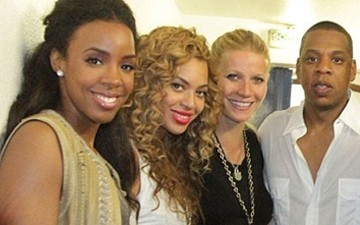
The black digerati had their panties in a tweet on Monday when Gwyneth Paltrow — ever the antithesis of all that is negro — tweeted a pic of herself on stage in Paris with Kanye and Jay-Z along with the caption: “Ni**as in paris for real.” Naturally, minutes later the headline “Gwyneth Paltrow Tweets the N-Word” then spread like wildfire on the interwebs.
Paltrow was in Paris attending Jay and Kanye’s “Watch the Throne” tour — so she got the Paris part right. Less clear to Paltrow was the fact that we don’t now, nor have we ever needed her to cleverly kick song titles with the N-word back to us. Yes, it is the title of a Jay and Kanye hit song (Paltrow responded to the criticism in a follow up tweet: “Hold up, it’s the title of the song!”), but, um, we knew that homegirl.
Tough to say whether it would be more or less offensive if Paltrow had tweeted a picture of just the fellas rather than the one with herself in it, too. The implication of the latter being that she is also a ni**a — the very notion of which makes me want to stick my head in the oven. But this isn’t really about the use of the N-word, much as I abhor it, and in a way I never imagined I would until I had a son.
This to me is more about our deep ambivalence toward mainstream cultural integration. More
Gwyneth, the N-Word and Why We’re to Blame
By Damon Young, TheRoot.com
At face value, there is nothing truly provocative about a (presumably) intoxicated person committing a social faux pas while partying with her equally intoxicated friends. But since this person is famous and white, and since the faux pas committed happened to involve a word that Farai Chideya once called “the nuclear bomb of racial epithets,” we (“we” in this case equals “people who read”) are contractually obligated to discuss, dismiss, dissect and deconstruct Gwyneth Paltrow’s “N**gas in Paris” tweet from every conceivable angle.
And, as is the case with most stories involving people we’ll never meet doing things that will have absolutely no impact on our lives, the discussions about the various takes on Paltrow’s “slip” are far more interesting than the actual story itself….
I won’t say that our feelings have “evolved” — evolution implies a change both organic and positive, and I’m not so sure that the gradual cultural softening of “nigger” is a good thing — but every time it is used in popular songs written by the president’s favorite rappers or freely incorporated by someone speaking in front of an audience that’s not all black, a piece of the shield of self-righteous outrage surrounding the word chips off.
Most of the discussion about this story reflects this sentiment as well, as even true militants and people who are still deeply hurt whenever “nigga” or “nigger” is used by any nonblack person preface their feelings with an acknowledgment that this — nonblacks allowing the word to slip so easily — is partially our fault for making it so ubiquitous, an act that subtly lets anyone who’s not black off the hook for thinking it was OK to use the word so freely. More.
Comments Are Welcome
Note: We moderate submissions in order to create a space for meaningful dialogue, a space where museum visitors – adults and youth –– can exchange informed, thoughtful, and relevant comments that add value to our exhibits.
Racial slurs, personal attacks, obscenity, profanity, and SHOUTING do not meet the above standard. Such comments are posted in the exhibit Hateful Speech. Commercial promotions, impersonations, and incoherent comments likewise fail to meet our goals, so will not be posted. Submissions longer than 120 words will be shortened.
See our full Comments Policy here.